7 Important Applications of an Environment Test Chamber in Modern Manufacturing
Learn how an Environment Test Chamber supports temperature, humidity, reliability, quality control, and product validation for modern manufacturing.
Story details
- Written by
- TASO Metrology
- Published
- Read time
- 7 min
- Reads
- 10
In brief
Article summary
Learn how an Environment Test Chamber supports temperature, humidity, reliability, quality control, and product validation for modern manufacturing.
Products used in automotive, electronics, aerospace, and industrial environments must perform reliably under changing environmental conditions. Temperature fluctuations, humidity, and other controlled environmental stresses can affect materials, components, and assemblies over time. For manufacturers, identifying these potential weaknesses before products reach customers is an important part of quality assurance.
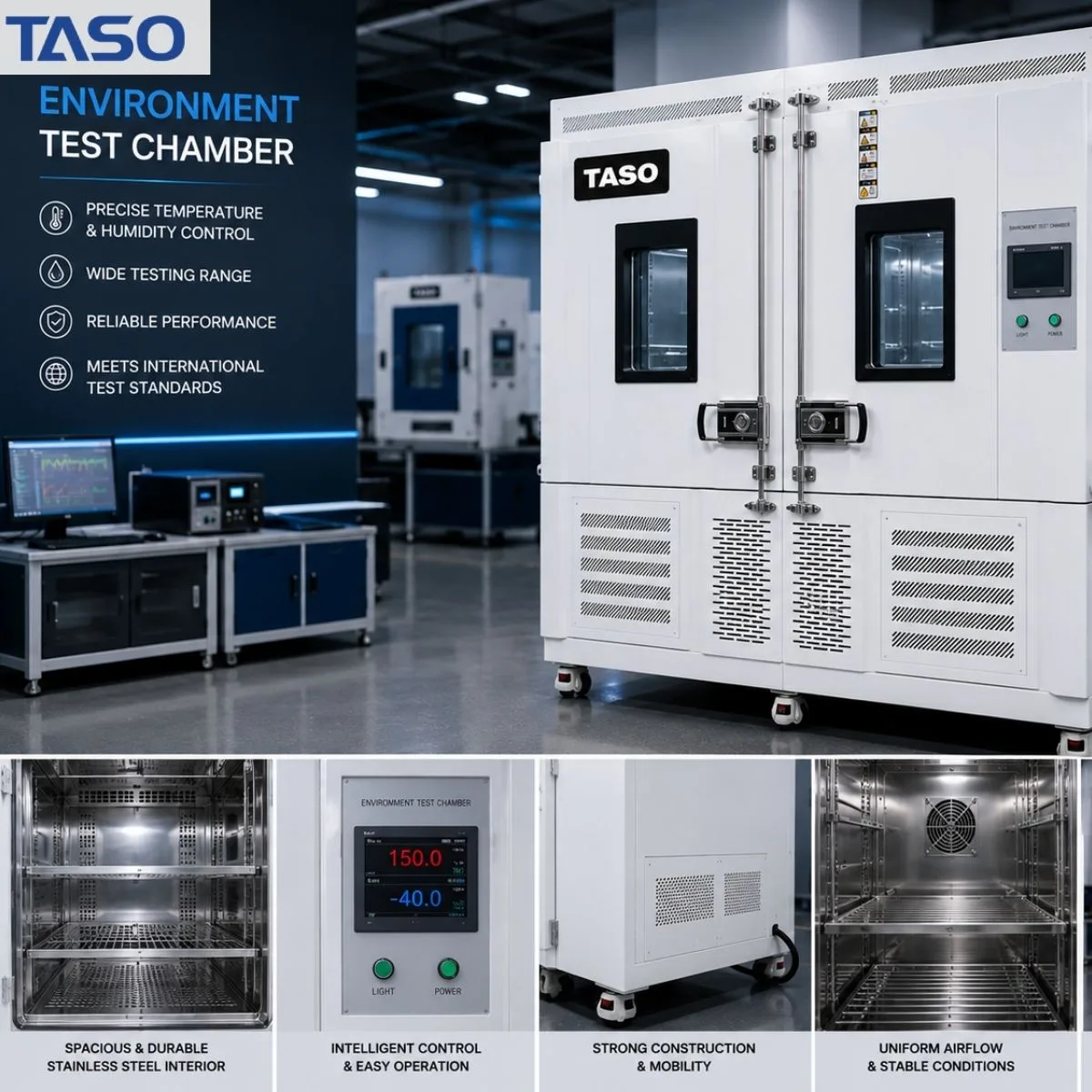
An Environment Test Chamber provides a controlled space where manufacturers and laboratories can expose products or materials to defined environmental conditions. These systems support product development, quality control, reliability testing, and validation across a wide range of industries.
What Is an Environment Test Chamber?
An Environment Test Chamber is a controlled testing system designed to simulate specific environmental conditions and observe how a product, material, or component responds.
Depending on the equipment configuration, environmental test chambers can control conditions such as temperature and humidity. Testing parameters are selected according to the product, intended application, and applicable testing procedure.
For U.S. manufacturers, this controlled approach can provide useful information that may not be obtained through ordinary ambient-condition inspection.
1. Supports Temperature Testing
Temperature can influence the dimensional stability, physical properties, electrical performance, and durability of many products.
An environmental test chamber allows engineers to expose test specimens to controlled temperature conditions and evaluate their response.
Applications may include:
Electronic components
Industrial equipment
Automotive parts
Electrical products
Plastics and materials
Product assemblies
By controlling the test environment, engineers can investigate how products behave under specified temperature conditions.
2. Helps Evaluate Humidity Resistance
Humidity can affect materials, electrical components, coatings, packaging, and assemblies.
An Environment Test Chamber with humidity-control capability can help manufacturers evaluate product behavior under controlled temperature and moisture conditions.
For example, electronics manufacturers may use environmental testing to investigate potential moisture-related issues during product development or validation. The specific test conditions should be established according to the product requirements and applicable test method.
3. Supports Product Reliability Testing
Reliability testing helps manufacturers understand how products respond to defined environmental stresses.
Environmental test equipment can be incorporated into development and validation programs to assess product behavior before large-scale production or market release.
For U.S. manufacturers, this can be particularly relevant when products are expected to operate across different climates or environmental conditions.
Testing results can help engineering teams investigate weaknesses, compare designs, and make informed decisions about materials and construction.
4. Helps Improve Quality Control
Quality control is not limited to dimensional inspection. Environmental conditions can also influence product performance and durability.
An Environment Test Chamber can support controlled testing as part of a broader quality-assurance process. Manufacturers may use environmental testing during incoming inspection, production evaluation, product validation, or failure investigation.
Controlled testing can help teams generate repeatable test conditions and document how products respond to specified environmental exposure.
5. Supports Automotive and Aerospace Applications
Automotive and aerospace products may be exposed to changing environmental conditions during transportation, storage, and operation.
Environmental testing can therefore play a role in evaluating relevant components and materials.
In automotive applications, testing may involve electronic assemblies, sensors, electrical components, plastics, seals, or other products depending on the applicable requirement.
In aerospace manufacturing, environmental testing may be incorporated into product development and qualification programs where temperature or humidity exposure is relevant.
The actual testing conditions should always be determined according to the component, application, and applicable specification.
6. Helps With Product Development and Validation
Environmental testing can provide valuable information during research and development.
Engineers can use controlled testing to compare prototypes, evaluate material choices, investigate failure modes, and understand how environmental conditions affect product behavior.
This makes environmental test chambers useful not only for final quality inspection but also during earlier stages of product development.
For example, an electronics development team may compare different enclosure or component designs under controlled temperature and humidity conditions before moving toward production.
7. Supports Specialized Thermal Shock Testing
Not every environmental test requires the same equipment. Some applications specifically require rapid transitions between significantly different temperature conditions.
This is where a Thermal Shock Chamber can be more appropriate than a general environmental test chamber.
A Thermal Shock Chamber is designed for thermal shock testing, where test specimens are exposed to rapid transitions between controlled hot and cold conditions according to the applicable test procedure.
The purpose is to investigate how rapid temperature changes may affect materials, components, or assemblies.
Therefore, while an Environment Test Chamber provides broader controlled environmental testing capabilities, a Thermal Shock Chamber is designed for applications where rapid temperature transitions are a key part of the test.
Environment Test Chamber vs. Thermal Shock Chamber
Factor | Environment Test Chamber | Thermal Shock Chamber |
Main purpose | Controlled environmental exposure | Rapid temperature-transition testing |
Typical conditions | Temperature and, depending on configuration, humidity | Hot and cold temperature zones or rapid transitions |
Main application | Environmental conditioning and reliability testing | Thermal shock evaluation |
Suitable for | Materials, components, assemblies, and products | Products requiring rapid temperature-change testing |
Selection basis | Environmental requirements | Thermal transition and test-method requirements |
The two systems can serve different testing objectives, so buyers should identify their actual test requirements before selecting equipment.
What Should U.S. Buyers Consider Before Choosing an Environment Test Chamber?
Selecting environmental test equipment requires more than comparing basic product descriptions.
U.S. manufacturers and laboratories should evaluate:
Required temperature range
Humidity range, if applicable
Chamber capacity
Test specimen size
Temperature and humidity control
Stability and uniformity
Controller and monitoring system
Data logging capabilities
Safety features
Applicable testing standards
Calibration requirements
Maintenance requirements
Technical documentation
Supplier experience
After-sales technical support
The chamber should be selected according to the intended testing procedure and product requirements rather than simply choosing the largest or most feature-rich system.
Environment Test Chamber Buyer Checklist
Before purchasing environmental testing equipment, ask:
What environmental conditions must be simulated?
What temperature and humidity ranges are required?
What are the dimensions and quantity of test specimens?
Is humidity control necessary?
Are rapid temperature transitions required?
What data-recording capabilities are needed?
What calibration process will be used?
Which testing standards or procedures apply?
What maintenance and technical support are available?
Can the supplier support international B2B requirements?
Why Consider TASO Metrology?
TASO Metrology is a China-based manufacturer and international supplier of precision metrology and environmental testing equipment, serving customers in the United States and other global markets.
For U.S. manufacturers, laboratories, engineers, and procurement teams, supplier selection should focus on application suitability, equipment specifications, manufacturing capabilities, technical documentation, calibration considerations, communication, and after-sales support.
TASO Metrology can be considered when evaluating environmental and precision testing solutions based on specific product requirements. Its product range, application-focused approach, manufacturing capabilities, and international B2B support can help industrial buyers explore suitable testing equipment for their applications.
Conclusion
An Environment Test Chamber provides manufacturers and laboratories with a controlled method for evaluating products under defined environmental conditions. From temperature and humidity testing to product reliability, quality control, and development activities, environmental testing can provide useful information for engineering and manufacturing decisions.
A Thermal Shock Chamber, meanwhile, is more specifically suited to applications involving rapid temperature transitions. Understanding this distinction can help U.S. buyers select equipment that matches their actual testing objectives.
For organizations evaluating environmental test equipment, the right choice should be based on required environmental conditions, chamber capacity, control capabilities, applicable testing procedures, calibration, and supplier support.
TASO Metrology, as a China-based international supplier, serves U.S. and global industrial customers with precision metrology and testing solutions. Businesses can discuss their specific environmental testing requirements with TASO Metrology to identify an appropriate equipment solution.
Frequently Asked Questions
Q1. What is an Environment Test Chamber?
An Environment Test Chamber is a controlled testing system used to expose products, materials, or components to specified environmental conditions such as temperature and, depending on configuration, humidity.
Q2. What is an Environment Test Chamber used for?
It can be used for environmental exposure, reliability testing, quality control, product validation, research and development, and failure investigation.
Q3. What is the difference between an Environment Test Chamber and a Thermal Shock Chamber?
An Environment Test Chamber is generally used for controlled environmental conditioning, while a Thermal Shock Chamber is designed for rapid transitions between different temperature conditions.
Q4. Which industries use environmental test chambers?
Automotive, aerospace, electronics, electrical, industrial manufacturing, consumer products, laboratories, and R&D organizations may use environmental testing equipment.
Q5. How do I choose the right Environment Test Chamber?
Consider the required temperature and humidity ranges, chamber capacity, control performance, specimen size, data logging, safety features, calibration, applicable test procedures, and technical support.

About the author
TASO Metrology
TASO Metrology Co., Ltd. is a leading manufacturer and global supplier of precision metrology and testing equipment. The company specializes in advanced dimensional measurement systems, vision measuring machines (VMM), CNC optical inspecti…
Last updated . If you spot an error, contact our newsroom with the article link and supporting information.