Reducing Downtime Through Intelligent Embedded Software
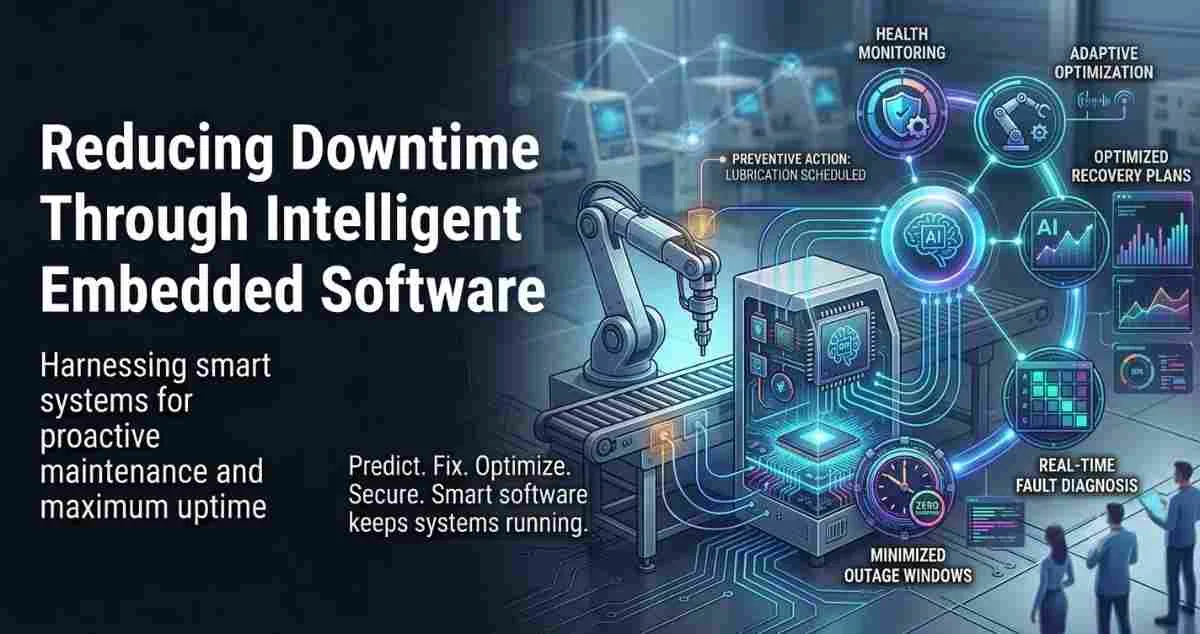
make it shoer Unplanned downtime costs manufacturers billions each year, and smarter embedded software, not new hardware, is closing the gap. By catching failures weeks in advance, it turns emergency repairs into scheduled maintenance and cuts downtime by up to 50%.
Story details
- Written by
- William Smith
- Published
- Read time
- 7 min
- Reads
- 8
In brief
Article summary
make it shoer Unplanned downtime costs manufacturers billions each year, and smarter embedded software, not new hardware, is closing the gap. By catching failures weeks in advance, it turns emergency repairs into scheduled maintenance and cuts downtime by up to 50%.
Unplanned downtime costs manufacturers an estimated $50 billion a year, according to a widely cited Deloitte analysis of industrial operations, with Siemens research putting the average outage at nearly $125,000 per hour. An intelligent embedded software development solution addresses this directly: rather than executing fixed instructions until something breaks, it monitors equipment health in real time, flags anomalies before they cause failures, and adapts behavior to actual operating conditions. That shift, from static firmware to self-monitoring systems, is what's driving fewer breakdowns and shorter, better-planned maintenance windows across manufacturing, energy, healthcare, and logistics.
Why Traditional Embedded Systems Struggle With Downtime
Most legacy embedded architectures were never designed for predictive capability.
They were built to perform a task reliably under expected conditions, not to reason about their own state or anticipate wear. That gap shows up in three consistent ways across industrial and IoT deployments.
Reactive fault detection: Traditional firmware typically reports a failure only after it happens, a sensor stops responding, a motor stalls, a voltage spikes past a threshold. By the time the system flags the issue, production has already stopped.
Limited visibility into subsystem behavior: Many embedded controllers operate as closed boxes. Engineers get a pass/fail signal, not the underlying telemetry that would explain why a component is trending toward failure.
Manual, calendar-based maintenance: Without real-time condition data, maintenance schedules default to fixed intervals. Parts get replaced too early, wasting budget, or too late, causing exactly the downtime the schedule was meant to prevent.
None of this is a hardware problem. It's an intelligence gap in the software governing the hardware.
What Makes Embedded Software "Intelligent"
The term gets used loosely, so it's worth being specific about what actually separates an intelligent embedded software development solution from a conventional one.
Real-Time Condition Monitoring
Intelligent embedded systems continuously sample data from sensors, actuators, and communication buses, then process that data locally rather than waiting for a batch upload to the cloud. This is the foundation everything else builds on: you can't predict a failure you're not measuring.
Edge-Based Analytics and Predictive Logic
Rather than sending raw data off-device for analysis, modern embedded platforms increasingly run lightweight models directly on the microcontroller or edge gateway. This matters for two reasons. First, latency: a system deciding whether to shut down a motor before it seizes can't wait on a round trip to a remote server. Second, bandwidth: constantly streaming raw sensor data from thousands of field devices is neither practical nor affordable at scale.
Over-the-Air (OTA) Update Capability
Static firmware ages badly. An intelligent embedded architecture supports secure OTA updates, meaning bug fixes, new predictive models, and security patches can be pushed to deployed devices without a truck roll or a production line stoppage.
Fault-Tolerant, Self-Healing Behavior
Beyond detection, intelligent systems can take corrective action on their own, throttling a process, rerouting a workload, or switching to a redundant component, before human intervention is even required.
Put together, these capabilities move embedded software from a passive executor of instructions to an active participant in equipment health management.
Predictive Maintenance: The Core Downtime Lever
If there's one capability that does the most work in reducing downtime, it's predictive maintenance built directly into the embedded layer.
McKinsey's research on predictive maintenance in manufacturing found that companies applying it typically see maintenance costs drop by 10 to 40 percent and unplanned downtime fall by up to 50 percent, alongside longer equipment lifespan. Those figures come from analytics applied at the enterprise level, but the underlying data has to originate somewhere. Increasingly, it originates in the embedded firmware itself.
Here's the mechanical difference. A vibration sensor on an industrial pump, paired with intelligent embedded software, doesn't just record a vibration reading. It compares that reading against a learned baseline, detects the specific frequency signature associated with bearing wear, and triggers a maintenance alert weeks before the bearing would have failed outright. The pump keeps running. The maintenance team schedules the fix on their terms, not the machine's.
This pattern repeats across industries:
Automotive manufacturing: Embedded controllers on robotic welding arms track motor current draw and thermal patterns to predict actuator failure before a weld defect occurs.
Energy and utilities: Smart grid controllers use embedded anomaly detection to isolate faults on transmission lines in milliseconds, preventing cascading outages.
Medical devices: Embedded diagnostics in infusion pumps and imaging equipment flag component degradation, keeping critical care equipment operational and audit-compliant.
Cold chain logistics: Embedded temperature controllers in refrigerated transport detect compressor inefficiencies early, protecting perishable cargo and avoiding costly spoilage claims.
In each case, the intelligence lives close to the hardware, not in a dashboard three systems removed from the machine itself.
A Closer Look: Predictive Failure Detection on the Factory Floor
Consider a mid-sized industrial equipment manufacturer running a fleet of CNC machines across multiple production sites. Under a conventional setup, spindle failures were discovered only when the machine threw an error code, typically mid-cycle, halting the batch and requiring a technician callout.
After integrating an intelligent embedded software layer, the same machines began monitoring spindle vibration, temperature, and motor load continuously. The embedded controller ran a lightweight edge model trained to recognize the early signature of bearing degradation, a pattern that historically preceded failure by two to three weeks.
The operational shift was significant. Maintenance teams began receiving alerts days ahead of failure instead of learning about problems after a machine had already stopped. Spare parts got ordered against actual need rather than a fixed calendar. Technicians scheduled repairs during planned downtime windows instead of responding to emergencies.
This is the pattern that shows up whenever embedded intelligence replaces reactive monitoring: the failure event itself doesn't disappear, but it gets pulled forward in time, into a window where it can be managed rather than merely survived.
Measuring the ROI of Intelligent Embedded Software
Downtime reduction is easy to talk about in the abstract and harder to quantify without a clear framework. Engineering and operations teams evaluating an embedded software investment should look at four measurable categories.
1. Mean Time Between Failures (MTBF): Intelligent monitoring extends MTBF by catching degradation before it becomes a full failure. Tracking this metric before and after deployment gives a direct read on whether the predictive logic is actually working.
2. Mean Time to Repair (MTTR): Because intelligent systems often localize the fault (identifying which component and why) rather than just flagging that something is wrong, technicians spend less time diagnosing and more time fixing. Shorter MTTR compounds across every incident.
3. Maintenance Cost per Unit of Output: Condition-based maintenance, informed by real embedded telemetry, typically reduces both premature part replacement and emergency repair costs. This shows up directly on the maintenance budget line.
4. Overall Equipment Effectiveness (OEE): OEE combines availability, performance, and quality into a single score. Since unplanned downtime is one of OEE's biggest drags, gains in availability from predictive embedded systems tend to move the overall OEE number in a way that's visible to plant leadership, not just the engineering team.
None of these metrics require exotic instrumentation. Most manufacturers already track versions of them. What changes is the input data feeding those numbers, moving from calendar-based assumptions to continuous, device-level evidence.
Designing an Embedded Software Development Solution for Downtime Reduction
Not every embedded project needs the full weight of edge AI and predictive models on day one. But a few architectural decisions matter regardless of scale.
Build for observability from the start: Retrofitting telemetry into an existing embedded product is far more expensive than designing it in. Even basic logging of sensor values, error states, and system events pays off later when you want to layer predictive logic on top.
Choose hardware with headroom: Predictive models, even lightweight ones, need processing capacity. Selecting a microcontroller purely on cost, with no margin for future compute needs, tends to force a full redesign a year or two down the road.
Prioritize secure, reliable OTA infrastructure early: Predictive models improve with more field data. Without a safe way to push updated models and firmware to deployed devices, that improvement cycle stalls.
Treat cybersecurity as part of reliability, not a separate workstream: An intelligent embedded system connected to a network is also a system that can be attacked. A security failure that takes a device offline causes the exact downtime the predictive layer was built to prevent.
Validate against real operating conditions, not lab conditions: Vibration signatures, thermal patterns, and load profiles in a controlled test environment rarely match what happens on a noisy factory floor. Field validation, even a limited pilot, catches gaps that bench testing misses.
Final Thoughts
The economics here are straightforward. Downtime is expensive, predictable failure patterns exist inside most mechanical and electrical systems, and embedded software is now capable enough to catch those patterns before they turn into stoppages. The organizations pulling ahead aren't necessarily using more advanced hardware. They're using software that pays closer attention to the hardware they already have.
For engineering teams evaluating where to start, the highest-leverage move is usually the simplest one: build observability into the embedded layer before trying to build intelligence on top of it. Predictive maintenance, self-healing behavior, and OTA-driven improvement all depend on that foundation. Get the data pipeline right at the device level, and the rest of the intelligent embedded software development solution has something real to work with.

About the author
William Smith
I am a Technical Consultant and Content writer with over 5 years of experience. I have a deep understanding of the technical aspects of software development, and I can translate technical concepts into easy-to-understand language. I am als…
Last updated . If you spot an error, contact our newsroom with the article link and supporting information.