Why Food Delivery Businesses Are Switching to Automated Dispatch Systems
Story details
- Written by
- Siraj Timbaliya
- Published
- Read time
- 6 min
- Reads
- 26
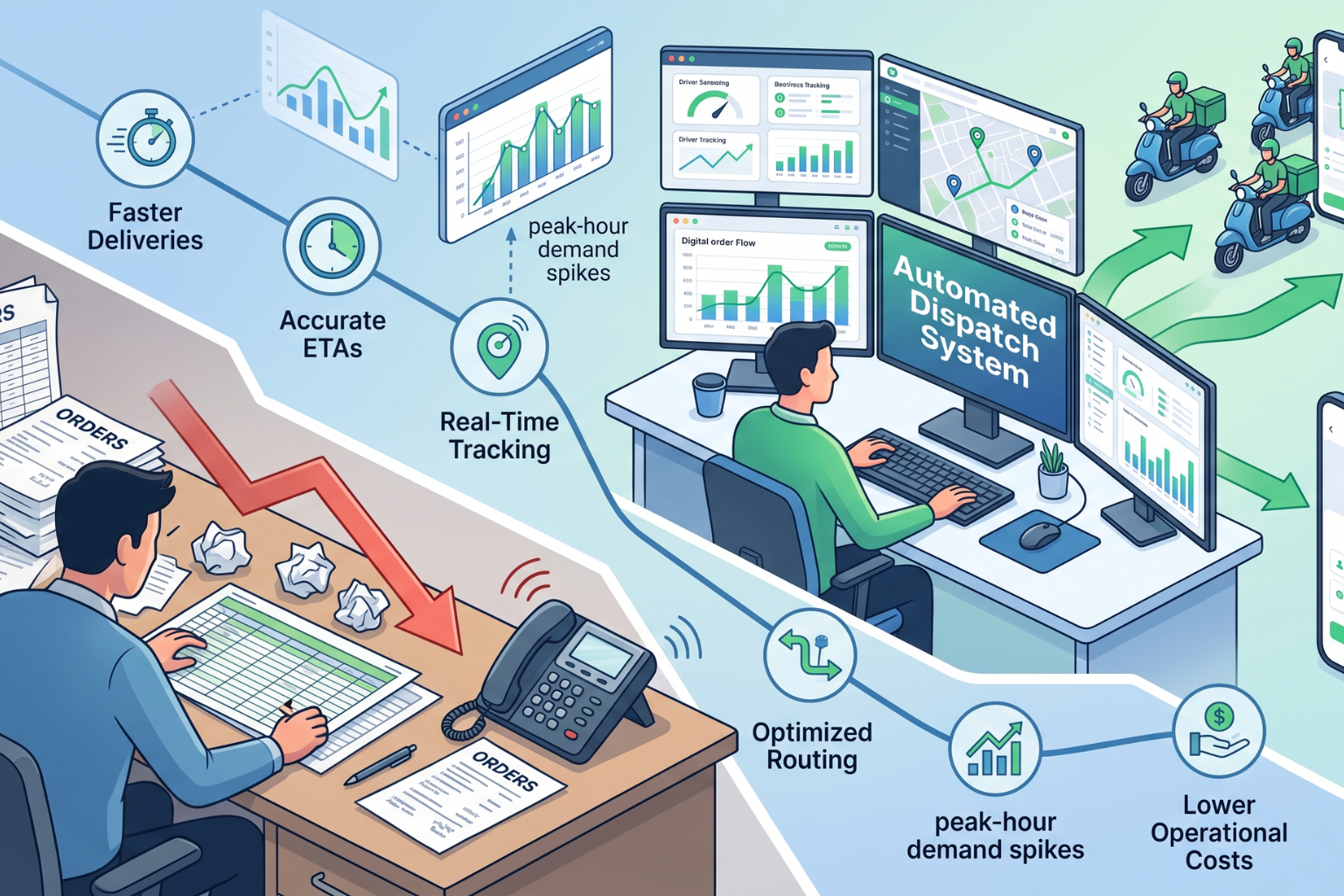
The food delivery industry has changed dramatically as customers increasingly expect faster deliveries, accurate estimated arrival times, and real-time order updates. For restaurants, cloud kitchens, food delivery platforms, and multi-location food businesses, meeting these expectations requires more than simply having enough drivers. Efficient dispatching has become a critical part of the delivery operation.
Traditional dispatch methods often depend on phone calls, spreadsheets, messaging apps, and manual decisions. While this approach may work for a small number of orders, it becomes increasingly difficult to manage during lunch and dinner rushes, weekends, promotions, and other high-demand periods. This is one of the major reasons food delivery businesses are moving toward automated dispatch systems.
The Problem With Manual Food Delivery Dispatch
Manual dispatch requires employees to monitor incoming orders, check driver availability, determine which driver is closest, communicate delivery details, and continuously follow up on delivery progress. As order volume increases, these tasks can quickly become overwhelming.
A dispatcher may assign an order to a driver who appears nearby, only to discover that the driver is already handling another delivery. Traffic conditions can also change the estimated delivery time, while a newly received order may require a different driver or route. Without real-time data, making these decisions accurately becomes difficult.
Research and industry examples show that automated dispatch can replace many of these repetitive decisions with software-driven assignment, routing, tracking, and real-time adjustments.
What Is an Automated Dispatch System?
An automated dispatch system is software that automatically matches food orders with suitable drivers based on real-time operational information. Instead of requiring a dispatcher to make every assignment manually, the system can evaluate factors such as driver location, availability, current workload, delivery priority, and route conditions.
Modern dispatch platforms can connect orders, drivers, mapping systems, tracking tools, and customer notifications into one workflow. When a new order arrives, the system can determine which available driver is best positioned to complete the delivery and send the assignment directly to the driver's application.
Faster Order Assignment
Speed is one of the biggest reasons businesses adopt automated dispatch systems. In a manual environment, every new order may require a dispatcher to check several pieces of information before assigning it. During peak hours, even small delays can accumulate.
Automated dispatch software can evaluate available drivers and assign orders almost immediately. This helps reduce the time between order preparation and driver assignment, allowing the delivery process to move forward without unnecessary waiting.
Faster assignment is especially valuable for food businesses because delivery time directly affects the customer experience. A meal that sits waiting for a driver can lose freshness, while longer delivery times can increase customer dissatisfaction.
Smarter Driver Allocation
Automated dispatch is not simply about finding the nearest driver. Effective systems can consider multiple operational factors before making an assignment.
Driver availability, current workload, location, delivery priority, vehicle requirements, and route conditions can all be incorporated into dispatch logic. This allows businesses to distribute orders more intelligently instead of repeatedly relying on manual judgment.
Better workload distribution can also reduce situations where one driver receives too many orders while another driver remains underutilized. Balanced assignments can help businesses make better use of their available delivery capacity.
Route Optimization Improves Delivery Efficiency
Food delivery businesses operate in environments where traffic, road closures, weather, and changing customer locations can affect delivery times. A driver may know a familiar route, but manual route selection does not always provide the most efficient option.
Automated dispatch systems can integrate mapping and route optimization capabilities to help drivers follow more efficient routes. Some systems can also reconsider routes when conditions change.
Route optimization can reduce unnecessary driving and help drivers complete more deliveries within their shifts. Industry examples highlight how combining automated assignment, order batching, and live-traffic routing can improve delivery efficiency.
Better Management During Peak Hours
Lunch and dinner rushes are challenging for food delivery businesses because order volume can increase rapidly within a short period. Manual dispatch systems often struggle during these spikes because dispatchers have to process many orders simultaneously.
Automation provides a more scalable approach. Software can continuously evaluate incoming orders and available drivers without requiring every decision to be made manually.
This allows dispatch teams to focus on exceptions and operational problems rather than spending the entire shift assigning individual orders. Automated dispatch is particularly useful for businesses managing larger fleets or multiple delivery zones.
Real-Time Delivery Visibility
Another important advantage is visibility. With manual dispatching, managers may need to contact drivers directly to find out where an order is or whether a delivery is delayed.
Automated systems can connect driver GPS information with a central dashboard, giving operations teams greater visibility into delivery progress. Customers can also receive status updates and estimated arrival information when the system supports customer-facing tracking.
Real-time visibility makes it easier to identify delays and take action before they become larger customer-service problems. Dispatch management platforms commonly combine assignment, tracking, scheduling, and route optimization to improve operational control.
Fewer Dispatching Errors
Human error is another challenge associated with manual delivery coordination. An order can be assigned to the wrong driver, an address can be communicated incorrectly, or a dispatcher may overlook an available driver during a busy period.
Automation reduces dependence on repetitive manual data entry and communication. When order and driver information is integrated into one system, assignments can be generated from current operational data.
Lower Operational Costs
Food delivery businesses operate on tight margins, making operational efficiency extremely important. Unnecessary driver mileage, excessive idle time, overtime, and inefficient workforce utilization can all increase delivery costs.
Automated dispatch can help address these issues by improving driver allocation and route planning. More efficient routes can reduce unnecessary travel, while better workload distribution can help businesses make greater use of their existing delivery resources.
Improved Customer Experience
Customers may not see the dispatch system directly, but they experience its impact through delivery speed, accuracy, and communication.
When orders are assigned quickly, routes are planned efficiently, and delivery progress can be tracked, customers are more likely to receive reliable estimated arrival times. Automatic notifications can also reduce uncertainty by keeping customers informed about their order status.
Automation Creates a More Scalable Delivery Operation
One of the biggest limitations of manual dispatch is scalability. A workflow that works for a small restaurant with a few drivers may become inefficient when the business expands to dozens of drivers, multiple locations, or hundreds of daily orders.
Automated dispatch systems are designed to process larger volumes of information without requiring the dispatch team to increase at the same rate. This makes automation particularly valuable for growing food delivery businesses.
Instead of adding more people simply to handle repetitive dispatch tasks, businesses can use software to automate routine decisions while allowing employees to concentrate on unusual situations, customer issues, and operational improvements.
The Future of Food Delivery Dispatch Is Automated
Food delivery businesses are under constant pressure to deliver faster while controlling costs and maintaining customer satisfaction. Manual dispatching can make these goals increasingly difficult to achieve as order volume grows.
Automated dispatch systems offer a more efficient alternative by combining automatic driver assignment, route optimization, real-time tracking, workload management, and delivery visibility. These capabilities help businesses respond more effectively to peak demand and build a delivery operation that can scale.
Powered by Froala Editor

About the author
Siraj Timbaliya
Contributor to TVL Health by The Viral Lines.
Last updated . If you spot an error, contact our newsroom with the article link and supporting information.