Sourcing Organic Sunflower Lecithin Powder: A Practical View for Procurement and R&D Teams
Story details
- Written by
- Rosy Brown
- Published
- Read time
- 4 min
- Reads
- 15
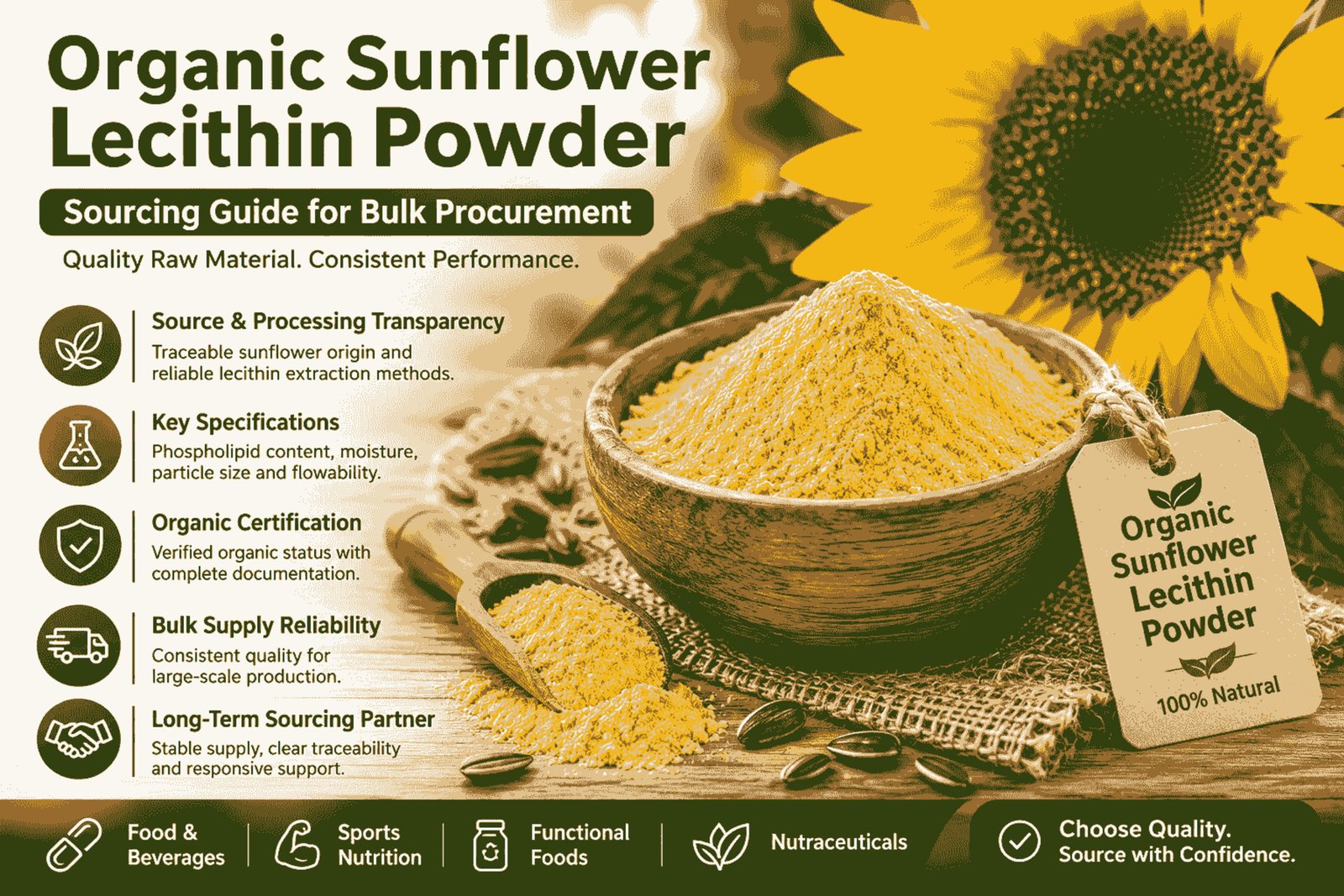
One of the more frustrating sourcing problems appears when an ingredient passes incoming quality checks but performs differently from the material used during product development. Sunflower lecithin can present exactly this challenge. Differences in processing, moisture, particle size, phospholipid composition, and storage conditions may influence dispersion, flow, and batch uniformity. For manufacturers, sourcing Organic Sunflower Lecithin Powder is therefore a matter of controlling variability, not simply finding an ingredient that meets a basic specification.
Start With the Job the Ingredient Must Perform
In most formulation projects, lecithin is selected for a functional reason. Sunflower lecithin contains phospholipids with surface-active characteristics that can support emulsification, wetting, dispersion, and processing.
The relevant performance criteria depend on the product. A powdered beverage may need rapid dispersion in water. A nutritional powder may require consistent distribution throughout a dry blend. Food manufacturers can have different requirements related to fat interaction, processing conditions, and texture.
This makes it risky to evaluate Sunflower Lecithin Powder on phospholipid content alone. Physical characteristics such as particle size, bulk density, moisture, and flow can have a direct effect on manufacturing performance.
Organic Qualification Requires Supply-Chain Visibility
For procurement teams purchasing Organic Sunflower Lecithin Powder, certification is only one part of the qualification process. The applicable organic certification should be verified for the actual ingredient and processing operation, with appropriate traceability throughout the supply chain.
It is also useful to establish the sunflower source, processing location, country of origin, and whether any carriers or processing aids are used. Such information can affect labeling, customer specifications, and certification requirements.
Conventional Sunflower Lecithin Powder should also receive structured technical review. Identity, microbiological quality, heavy metals, pesticide controls where relevant, allergen declarations, GMO status, and storage requirements are among the details that should be established before commercial approval.
Why Pilot Testing Can Mislead Buyers
A frequent sourcing observation is that laboratory performance does not always translate directly to production.
At small scale, operators have tight control over mixing speed, temperature, hydration time, and addition sequence. Commercial equipment may produce different shear conditions and process much larger ingredient loads. As a result, dispersion that appears straightforward in the laboratory may require process adjustments at scale.
Moisture is another variable. Higher moisture can contribute to caking or poor powder flow, while differences in particle-size distribution may affect blend uniformity and dispersion. Bulk density can also influence batching and packaging calculations.
For R&D teams, a better approach is to test prospective material under representative manufacturing conditions. Comparing multiple production lots can provide additional insight into whether the supplier delivers consistent functional performance.
What Should Be Included in the Procurement Specification?
A COA should provide the analytical foundation for approval. Depending on the application, buyers may specify phospholipid profile, phosphatidylcholine content where relevant, moisture, particle-size distribution, bulk density, microbiological limits, heavy metals, and identity parameters.
Additional documentation can include organic certification, allergen statements, GMO declarations, country-of-origin information, safety data, processing details, shelf life, and storage recommendations.
One practical step is to establish an approved reference sample. When a new lot arrives, the quality team can compare it with the reference for appearance, odor, flow, dispersion, and other agreed characteristics. This can help identify gradual changes that may not immediately trigger a specification failure.
The Hidden Cost of Inconsistent Material
Procurement teams sometimes focus heavily on price per kilogram, but ingredient variability can create costs elsewhere. If a lecithin powder behaves differently from the approved material, manufacturers may need additional testing, modified mixing conditions, longer processing times, or even formulation adjustments.
Supply reliability matters in the same way. Before committing to large volumes, sourcing teams should understand lead times, minimum order quantities, packaging formats, production capacity, and contingency options.
Storage and transportation should also be considered. Lecithin powder requires suitable protection from moisture and excessive heat. A well-qualified material can still develop handling issues if warehouse or transportation conditions are poorly controlled.
The More Useful Sourcing Benchmark
The strongest qualification process connects procurement requirements with actual formulation behavior. Organic Sunflower Lecithin Powder should be assessed for certification, traceability, analytical quality, and performance under realistic processing conditions.
The same principle applies to conventional Sunflower Lecithin Powder. A detailed COA can establish whether the material meets the agreed specification, but repeated production lots establish whether that specification translates into dependable manufacturing performance.
For sourcing teams, that distinction is important. The most useful ingredient is not simply the one that passes inspection. It is the one that continues to behave predictably after the purchase order, through storage and production, and across successive commercial batches.
Powered by Froala Editor

About the author
Rosy Brown
Contributor to TVL Health by The Viral Lines.
Last updated . If you spot an error, contact our newsroom with the article link and supporting information.