Is Salicylic Acid or Glycolic Acid Better for Post-Acne Marks?
Story details
- Written by
- Pers Active Lab
- Published
- Read time
- 6 min
- Reads
- 27
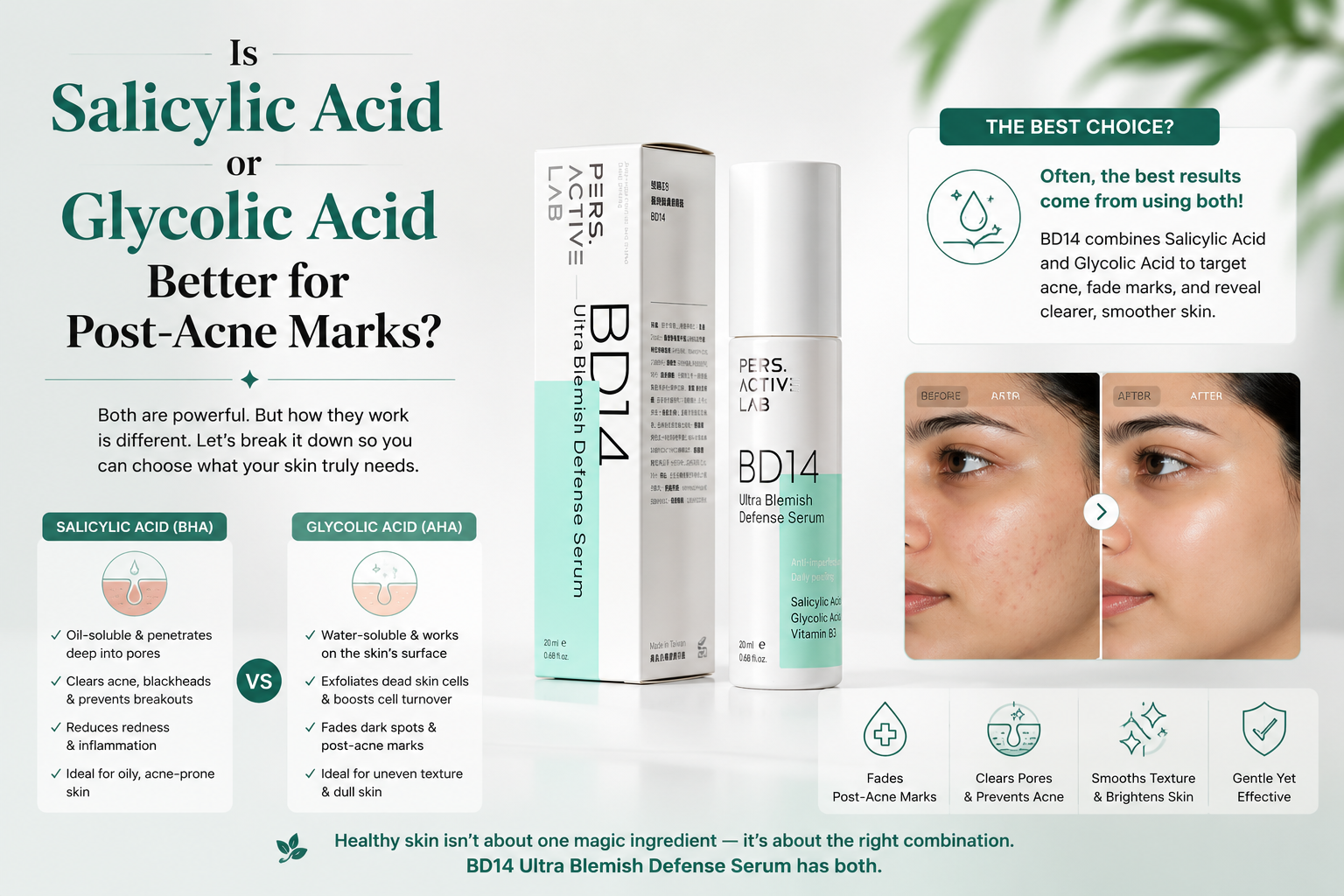
Post-acne marks test the patience of even the most disciplined skincare routine. You finally get a breakout under control, and days later, a stubborn red or brown mark takes its place. If you've stood in front of a shelf of exfoliating acids wondering which one actually fades these marks faster, you're asking the right question. Salicylic acid and glycolic acid both work, but they work differently, and knowing the difference changes how you treat your skin.
Understanding Post-Acne Marks First
Not all post-acne marks are the same, and this matters more than most people realize. Some marks are flat, discolored patches called post-inflammatory hyperpigmentation, or PIH. Others are indented or textured scars from deeper tissue damage. Acids help most with the first type. They don't rebuild lost tissue, but they do speed up how quickly discolored skin cells shed and get replaced with fresh, evenly toned skin.
Your skin naturally renews itself, but the process slows down after inflammation. Dead, pigmented cells sit on the surface longer than they should. This is where exfoliating acids step in and push that process along.
How Salicylic Acid Works on Marks
Salicylic acid is an oil-soluble beta hydroxy acid, which means it slips past the oil sitting inside your pores instead of just sitting on the surface. It reaches into clogged follicles, breaks down excess sebum and dead skin buildup, and calms the inflammation that often triggers new marks in the first place.
This makes salicylic acid particularly useful if your post-acne marks come with active breakouts still happening around them. Treating new inflammation early reduces the chance of it turning into another mark down the line. A well-formulated salicylic acid serum for acne does double duty here it clears the pores causing fresh breakouts while gently smoothing the marks left behind from old ones.
Salicylic acid also has a natural anti-inflammatory effect, related to its chemical connection to aspirin. This means it tends to be gentler on inflamed, red marks specifically, since it calms irritation while it exfoliates rather than adding to it.
How Glycolic Acid Works on Marks
Glycolic acid is an alpha hydroxy acid derived from sugar cane, and it has the smallest molecular size among AHAs. That small size lets it penetrate the skin's surface quickly and effectively, loosening the bonds between dead skin cells across the entire face rather than focusing inside pores.
Because it works broadly across the skin's surface, glycolic acid tends to shine on flat, brown discoloration and overall dullness that surrounds acne marks. It resurfaces skin evenly, which helps marks blend into surrounding tone faster. Many people notice a brighter, smoother complexion within a few weeks of consistent use.
Glycolic acid doesn't have the same pore-clearing or anti-bacterial action as salicylic acid, so it isn't the strongest choice if you're still dealing with active, inflamed acne. It performs best once breakouts have calmed down and you're purely focused on evening out tone.
So Which One Is Actually Better?
The honest answer is that it depends on what your marks look like and what your skin is doing right now.
If you have active acne alongside old marks, salicylic acid usually wins because it addresses the root cause clogged, inflamed pores while still fading existing discoloration. If your acne has cleared and you're left mainly with flat, brownish spots and uneven tone, glycolic acid often works faster because of how thoroughly it resurfaces the skin.
For many people, the real answer isn't choosing one over the other. It's using both, at the right time and in the right combination. A formula that pairs salicylic acid with glycolic acid lets you treat clogged pores and uneven pigmentation in a single step, without needing two separate products layered on top of each other. This dual-acid approach tends to suit combination or acne-prone skin that also struggles with dullness and old marks.
Why Skin Type Changes the Answer
Oily and thicker skin generally tolerates both acids well and can often handle higher concentrations or more frequent use. Dry or sensitive skin needs a slower approach, since both acids exfoliate the skin barrier, and over-exfoliation can leave skin more reactive and prone to redness rather than less.
This is exactly why generic, one-size-fits-all advice on acne serums often falls short. What clears marks quickly on oily, resilient skin can irritate and worsen barrier function on dry or reactive skin. Matching acid type, strength, and frequency to your specific skin condition matters just as much as choosing the right ingredient in the first place.
This is also where Personalized skin care products offer a real advantage over grabbing whatever exfoliating serum is trending. Skin that's oily with active breakouts needs a different acid ratio and frequency than skin that's dry with old, flat marks and a compromised barrier. A formula built around your actual skin profile rather than a generic strength meant for everyone reduces the trial-and-error phase and lowers the risk of irritation while you wait for results. Instead of guessing between products, matching the acid combination and concentration to your skin's current needs gets you to visible improvement with far less setback along the way.
How to Introduce These Acids Without Irritation
Start slow, regardless of which acid you choose. Apply a pea-sized amount two to three times a week initially, and watch how your skin responds over the following days. Mild tingling on application is common and expected. Persistent redness, flaking, or burning is not, and signals that you need to scale back.
Apply exfoliating acids to clean, dry skin before your moisturizer, and always finish your morning routine with sun protection. Both acids increase your skin's sensitivity to UV exposure, and skipping sunscreen doesn't just risk sunburn it directly undoes the fading progress you're working toward, since fresh sun exposure on newly exfoliated skin can deepen pigmentation instead of clearing it.
Avoid stacking acids with retinol or vitamin C in the same routine until your skin builds tolerance. Introducing multiple active ingredients at once makes it harder to tell what's causing irritation if your skin reacts.
The Bottom Line
Salicylic acid earns its place when active breakouts and clogged pores are still part of the picture. Glycolic acid earns its place when your skin is calmer and you're mainly chasing even tone and brightness. For many people dealing with both concerns at once, a serum combining the two, matched to your skin's actual needs, offers the most efficient path to clearer, more even-toned skin.
Frequently Asked Questions
Can I use salicylic acid and glycolic acid together?
Yes, many formulas combine both safely at balanced concentrations. Using them together in one product is generally gentler than applying two separate strong acids back to back.
How long does it take to see results on post-acne marks?
Most people notice visible improvement within four to eight weeks of consistent use, though deeper or older marks can take longer to fully fade.
Will these acids remove acne scars completely?
They help with flat discoloration but have limited effect on textured or indented scarring, which usually requires additional treatments like microneedling or professional resurfacing.
Is it safe to use these acids every day?
Not initially. Start two to three times a week and increase frequency gradually only if your skin tolerates it without irritation.
Do I still need sunscreen if I use these acids at night?
Yes. Both acids increase sun sensitivity for days afterward, so daily sunscreen remains essential regardless of when you apply them.
Powered by Froala Editor

About the author
Pers Active Lab
Skin-Pal is a cutting-edge AI-powered skincare tech platform and personalized beauty solution designed to help individuals understand, analyze, and improve their skin with science-backed precision. Based in Taiwan and now launched in India…
Last updated . If you spot an error, contact our newsroom with the article link and supporting information.