Evaluating the True Cost of Organic Peppermint Leaf Powder in Commercial Formulations
Story details
- Written by
- Rosy Brown
- Published
- Read time
- 4 min
- Reads
- 8
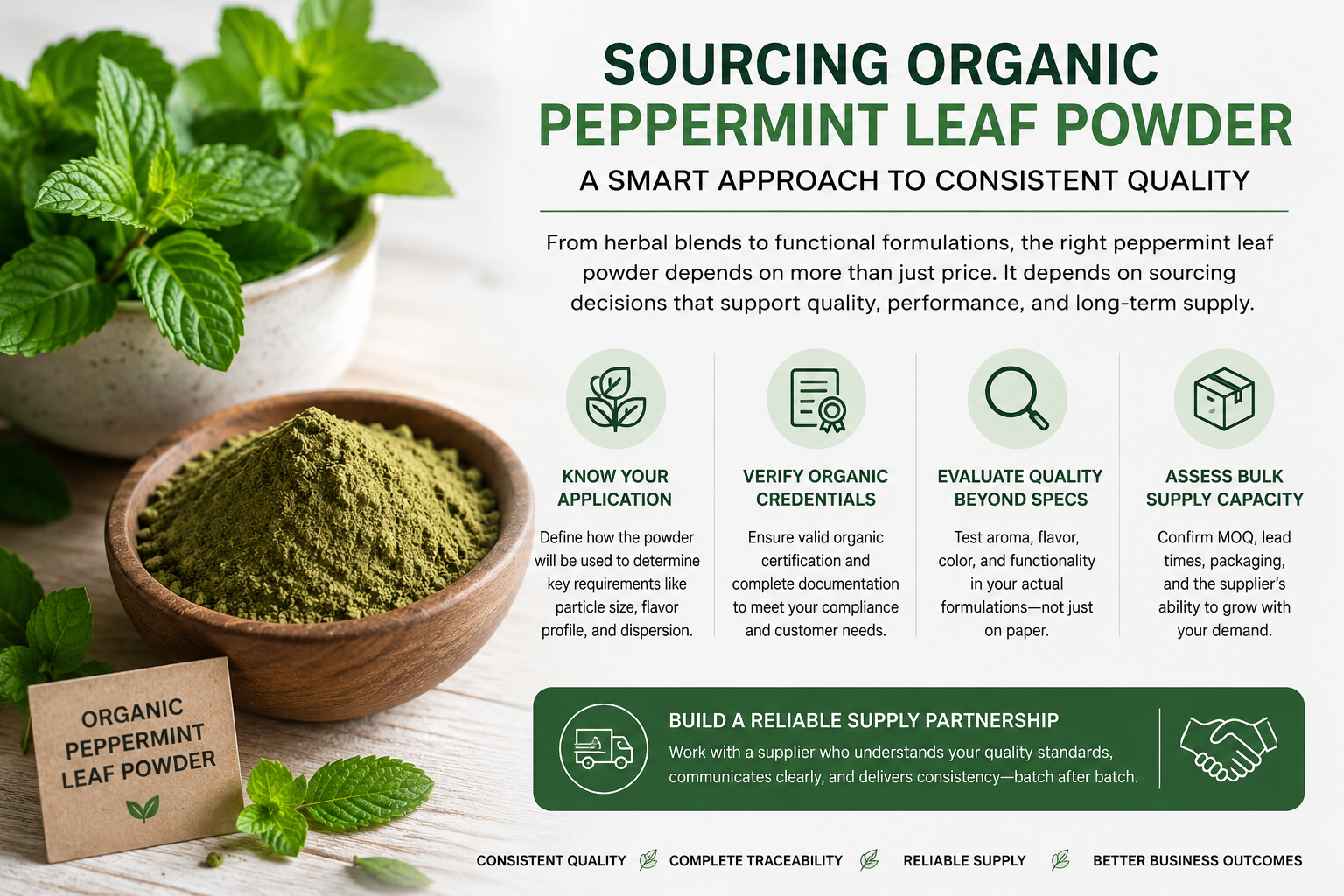
For procurement teams, the price listed on a supplier quotation is only one part of the purchasing decision. The real cost of an ingredient can also depend on formulation performance, consistency, testing requirements, logistics, storage, and production efficiency.
This is particularly relevant when sourcing Organic Peppermint Leaf Powder for commercial food, beverage, supplement, and botanical products. Companies purchasing Organic peppermint leaf powder bulk can benefit from evaluating the ingredient based on its total cost in use rather than focusing only on the price per kilogram.
Why Price Alone Can Be Misleading
Two suppliers may offer similar-looking peppermint powder at different prices. At first glance, the lower quotation may appear more attractive.
However, procurement teams should also ask whether both materials perform equally in the intended formulation.
Differences in particle size, moisture, aroma, flavor, or consistency can affect production and potentially require additional processing or formulation adjustments.
For this reason, the purchasing decision should consider both the unit price and the practical performance of the ingredient.
Start With the Formulation Requirement
R&D teams should define the role of peppermint powder before procurement compares suppliers.
The ingredient may contribute aroma, flavor, botanical content, color, or a combination of characteristics depending on the finished product.
The required specification can therefore include:
- Botanical identity
- Organic status
- Aroma
- Flavor
- Color
- Moisture
- Particle size
- Microbiological requirements
- Heavy metals
- Pesticide residues
- Shelf life
A clearly defined specification allows procurement to compare products based on actual application needs.
Consider Usage Rate
One important factor in cost-in-use is the amount of ingredient required to achieve the desired formulation result.
If two materials have different sensory or physical characteristics, the formulation team may use them at different inclusion levels.
R&D should therefore evaluate supplier samples in the intended product rather than comparing raw material characteristics alone.
A higher-priced ingredient may potentially provide better value if it meets the formulation requirement at a suitable usage level and performs consistently.
Evaluate Processing Efficiency
Ingredient performance can also affect manufacturing.
Particle size and moisture may influence powder flow, blending, filling, and handling.
For example, inconsistent material may require additional screening, blending, or process adjustments.
When purchasing Organic peppermint leaf powder bulk, procurement teams should discuss these factors with production and R&D before making a final supplier decision.
A product that moves efficiently through the manufacturing process can have value beyond its purchase price.
Account for Quality Testing
Testing is another component of total procurement cost.
Manufacturers may have internal requirements for identity, microbiological quality, moisture, heavy metals, pesticide residues, or other parameters.
Supplier documentation can influence how much incoming verification is required.
A supplier that consistently provides complete batch documentation can make quality review more efficient, although manufacturers should still follow their own approved testing procedures.
Review Batch Consistency
Consistency is directly connected to cost.
If batches vary significantly, R&D teams may need to investigate formulation differences or make adjustments.
Quality teams may also need additional testing when results fall outside expected ranges.
Before approving a supplier, manufacturers can evaluate multiple lots and compare relevant characteristics.
This provides more information about the expected consistency of Organic Peppermint Leaf Powder over time.
Include Logistics in the Calculation
Freight and handling can have a significant effect on the landed cost of bulk ingredients.
Procurement teams should consider:
- Shipping charges
- Packaging
- Minimum order quantities
- Delivery frequency
- Lead times
- Warehouse requirements
- Import or local logistics costs where applicable
A supplier located closer to the manufacturing facility may have different logistics economics from an overseas supplier, even when the quoted ingredient price appears higher or lower.
Evaluate Storage Requirements
Bulk purchasing can reduce ordering frequency, but it can also increase inventory exposure.
Before purchasing large quantities, warehouse teams should understand shelf life, storage conditions, packaging requirements, and inventory turnover.
If a manufacturer cannot consume the ingredient within the appropriate period, a lower bulk price may not create real savings.
Procurement should therefore align order quantities with actual consumption and storage capacity.
Consider Supply Reliability
Production interruptions can be more expensive than small differences in ingredient price.
A supplier's lead-time reliability, production capacity, inventory practices, and ability to respond to demand changes should therefore be part of the commercial evaluation.
For businesses purchasing Organic peppermint leaf powder bulk, reliable supply can support better production planning and reduce the need for emergency purchasing.
Build a Total-Cost Supplier Scorecard
A practical scorecard can combine the major cost factors.
Factor | What to Evaluate |
Ingredient Price | Cost per kg |
Formulation | Usage and performance |
Quality | Batch consistency |
Testing | Documentation and verification |
Logistics | Freight and delivery |
Storage | Shelf life and warehouse requirements |
Supply | Capacity and lead-time reliability |
Commercial Terms | MOQ and payment conditions |
This gives procurement a broader view of supplier value.
Align Procurement With R&D
The strongest cost-in-use analysis requires cooperation between departments.
R&D can evaluate formulation performance. Quality can assess consistency and documentation. Production can review processing behavior. Procurement can calculate landed and commercial costs.
Together, these teams can determine whether a supplier provides genuine value rather than simply a low quotation.
Conclusion
Evaluating Organic Peppermint Leaf Powder based solely on price can overlook important costs associated with formulation performance, quality control, logistics, storage, and supply reliability.
For manufacturers purchasing Organic peppermint leaf powder bulk, a cost-in-use approach provides a more complete framework for supplier selection.
By combining technical evaluation with commercial analysis, procurement teams can identify suppliers that support consistent formulation performance, efficient production, predictable supply, and sustainable long-term purchasing value.
Powered by Froala Editor

About the author
Rosy Brown
Contributor to TVL Health by The Viral Lines.
Last updated . If you spot an error, contact our newsroom with the article link and supporting information.