Organic Maitake Mushroom Powder Bulk: A Practical Sourcing Perspective for B2B Buyers
Story details
- Written by
- Rosy Brown
- Published
- Read time
- 4 min
- Reads
- 16
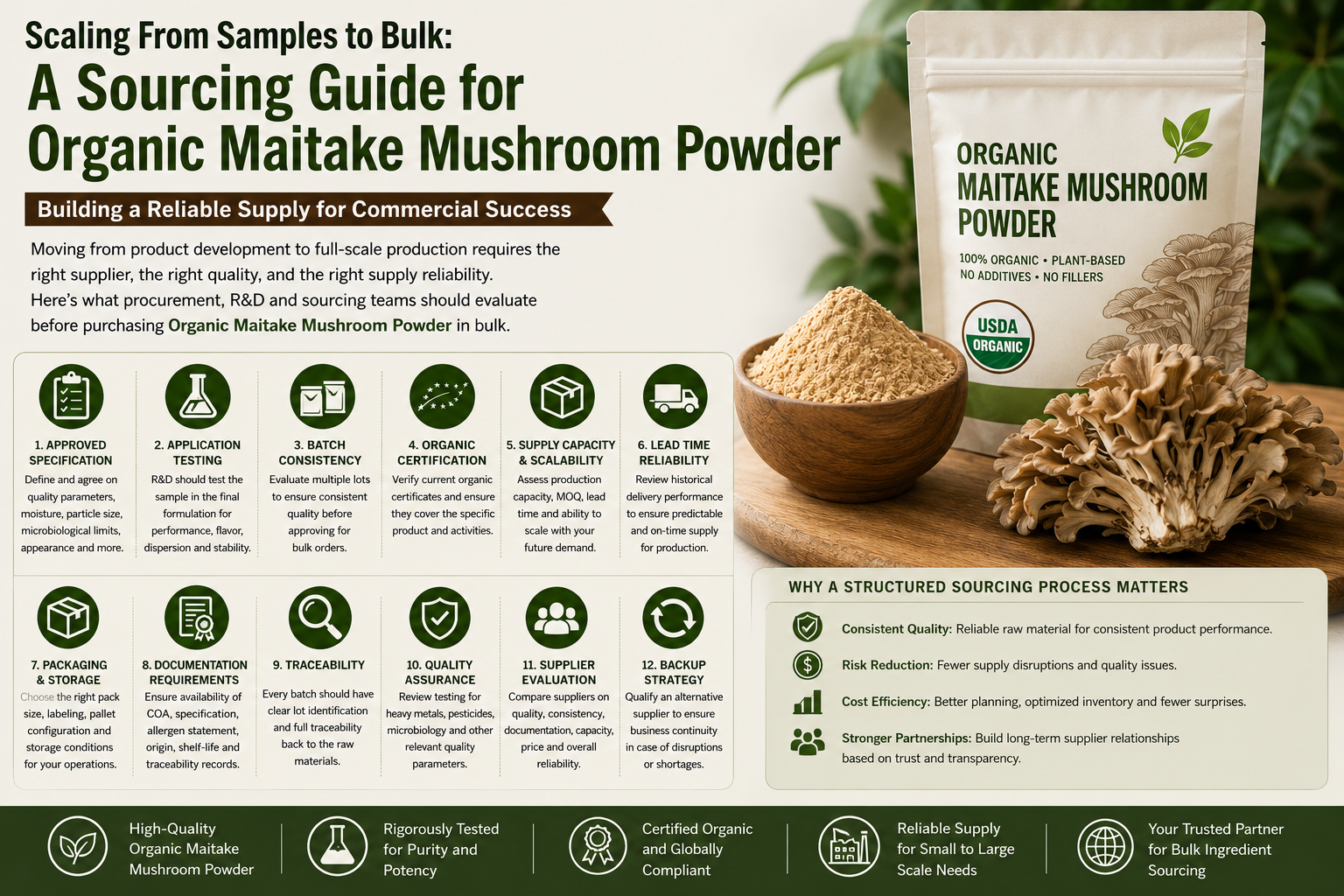
The most expensive ingredient problem is often not a failed batch. It is a raw material that changes just enough from one shipment to another to create repeated adjustments in formulation and production. With mushroom powders, this can happen when suppliers use different cultivation conditions, drying methods, milling specifications, or quality-control practices. For teams purchasing Organic Maitake mushroom Powder, qualifying the ingredient should therefore go beyond approving a single sample.
For procurement managers, formulators, and R&D teams, the more useful question is whether the material can deliver predictable performance across commercial lots.
Start With a Clear Raw Material Definition
Maitake, or Grifola frondosa, is an edible mushroom used in food, nutraceutical, and functional ingredient products. However, the term “maitake powder” can cover materials with different production characteristics.
Before comparing quotations, sourcing teams should establish exactly what they require. Is the powder produced from fruiting bodies or mycelium? What is the country of origin? What cultivation substrate is used? How is the material dried and milled?
These questions become especially important for Organic Maitake mushroom Powder, where the organic status must be supported by appropriate certification for the actual ingredient being supplied.
A detailed raw-material description gives procurement teams a much better basis for supplier comparison than product names alone.
Processing Can Influence Manufacturing Performance
One sourcing issue that is easy to underestimate is physical behavior. Two powders can have similar analytical specifications but behave differently during production.
Moisture content can influence caking and storage stability. Particle-size distribution can affect blending, dispersion, powder flow, and filling accuracy. Bulk density can also affect how much material occupies a given volume in automated processing equipment.
For powdered beverages, nutrition blends, capsules, tablets, and dry food mixes, these properties should be evaluated during formulation trials. A material that works smoothly at laboratory scale may require process changes if the commercial lot has different flow or density characteristics.
Sensory performance deserves attention as well. Maitake has a naturally earthy mushroom aroma and flavor. Its impact will depend on inclusion level and the surrounding formulation, so R&D teams should test the ingredient within the intended finished product rather than judging it only as a standalone powder.
Bulk Procurement Requires a Strong Specification
When sourcing Organic Maitake mushroom Powder Bulk, a certificate of analysis is important, but it should not be the entire qualification process.
Depending on the application, the purchasing specification may cover identity, moisture, ash, particle size, microbiological limits, heavy metals, pesticide residues, and other contaminants. Where specific compositional markers are required, the analytical method should also be defined.
This point becomes important when comparing suppliers. Results reported under different analytical methods may not provide a true like-for-like comparison, even when the numbers appear similar.
Procurement teams may also require organic certification, Non-GMO documentation, allergen statements, Kosher or Halal certification, SDS, country-of-origin information, and relevant food-safety documentation.
The Hidden Risk Is Lot-to-Lot Variation
A single approved sample does not necessarily demonstrate long-term supply consistency. Natural agricultural materials can vary because of cultivation conditions, substrate, harvest timing, drying parameters, milling, and storage.
For that reason, I would consider multiple-lot evaluation before approving a major Organic Maitake mushroom Powder Bulk program.
Laboratory testing should be supported by practical observations. Compare color, aroma, flowability, caking tendency, bulk density, and dispersion between lots. These characteristics can expose differences that may not appear in a standard COA.
It is also worth examining the supplier's production and inventory model. A buyer should know whether finished powder is stocked continuously, manufactured against purchase orders, or produced in seasonal or scheduled campaigns. Lead times, minimum order quantities, packaging, storage conditions, and shelf-life expectations can all affect supply planning.
Decide Between Powder and Extract Based on Need
Another important sourcing decision is whether the finished product requires a whole-mushroom powder or an extract. These formats serve different formulation objectives.
Whole-mushroom powder may be suitable when the broader mushroom material is desired. An extract can be more appropriate when the formulation requires a concentrated or more specifically defined fraction.
The right choice depends on dosage, sensory characteristics, processing conditions, analytical requirements, regulatory considerations, and cost-in-use—not simply on which specification appears more concentrated.
In the end, successful sourcing of Organic Maitake mushroom Powder Bulk comes down to consistency. A supplier should be able to demonstrate clear ingredient identity, controlled processing, appropriate documentation, and reliable performance across multiple lots. When procurement and R&D teams establish those criteria before negotiating volume, they reduce the risk of discovering formulation and manufacturing differences only after commercial production has begun.
Powered by Froala Editor

About the author
Rosy Brown
Contributor to TVL Health by The Viral Lines.
Last updated . If you spot an error, contact our newsroom with the article link and supporting information.