Why Organic Amla Fruit Powder Sourcing Demands More Than a Specification Sheet
Story details
- Written by
- Rosy Brown
- Published
- Read time
- 4 min
- Reads
- 3
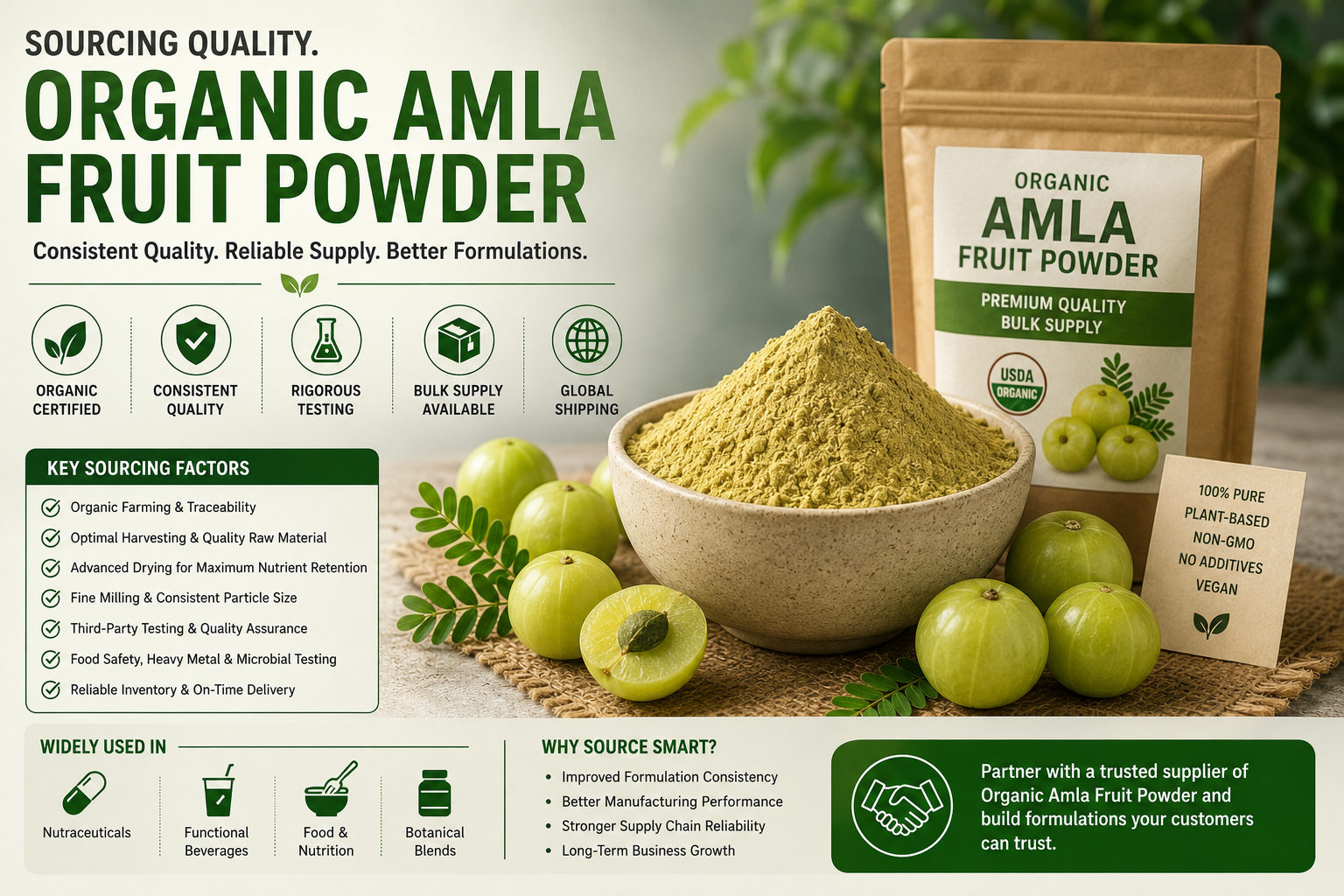
As demand for botanical and fruit-derived ingredients continues to grow across the US nutraceutical, functional beverage, and food industries, procurement teams are placing greater emphasis on supplier reliability, ingredient consistency, and long-term supply security. While documentation remains an important part of supplier qualification, many sourcing decisions today extend well beyond Certificates of Analysis and certification records.
Organic Amla Fruit Powder is one ingredient where sourcing practices can directly influence manufacturing performance. In our experience, procurement challenges rarely arise because the ingredient is unavailable. Instead, they emerge when batches with similar specifications behave differently during formulation or commercial production. Variations in cultivation, fruit maturity, drying technology, and milling processes often explain these differences.
For procurement managers, formulators, and R&D professionals, selecting a dependable supplier for organic amla powder bulk procurement requires evaluating both technical quality and operational capability.
Understanding Organic Amla Fruit Powder in Industrial Manufacturing
Organic Amla Fruit Powder is produced from organically cultivated Indian gooseberry (Phyllanthus emblica). The fruit is harvested at optimal maturity, cleaned, sliced, dried under controlled conditions, and milled into a fine powder suitable for industrial manufacturing. Commercial production is concentrated primarily in India, where established cultivation and processing infrastructure support global supply.
Although production methods are generally standardized, regional farming practices, seasonal weather conditions, and drying techniques can significantly influence the finished powder. Differences in moisture content, particle size, color, aroma, and flowability may not always appear in analytical reports but can affect large-scale manufacturing efficiency.
Manufacturers commonly choose Organic Amla Fruit Powder because it offers:
- Easy incorporation into powdered formulations
- Compatibility with clean-label product development
- Plant-based ingredient positioning
- Efficient storage and transportation compared with fresh fruit
- Versatile use across nutraceutical, beverage, and food applications
These characteristics continue to increase demand for organic amla powder bulk across commercial manufacturing sectors.
Why Procurement Teams Evaluate More Than Certifications
One sourcing lesson we often encounter is that certifications alone rarely predict production performance. While Organic certification, Certificates of Analysis (COAs), microbiological testing, heavy metal reports, allergen statements, and MSDS documentation remain essential, experienced buyers routinely evaluate additional operational indicators.
These commonly include:
- Farm and harvest traceability
- Fruit maturity at harvest
- Drying methodology
- Moisture control
- Particle size consistency
- Batch-to-batch color uniformity
- Packaging integrity
- Inventory planning and supply continuity
These characteristics frequently determine whether an ingredient performs consistently throughout commercial production.
A supplier may provide complete documentation while still delivering noticeable differences between production lots because of variations in post-harvest processing.
Technical Considerations During Formulation
From a formulation perspective, Organic Amla Fruit Powder performs well in numerous dry manufacturing systems. However, production-scale processing often highlights differences that laboratory evaluations may not detect.
Nutraceutical Applications
Organic Amla Fruit Powder is widely incorporated into:
- Capsules
- Tablets
- Powdered supplement blends
- Stick packs
- Botanical formulations
Formulators typically monitor:
- Powder flowability
- Moisture stability
- Uniform particle size
- Blend consistency
- Dust generation
- Storage performance
Maintaining these characteristics helps improve manufacturing efficiency and finished product consistency.
Functional Food and Beverage Applications
Food and beverage manufacturers utilize Organic Amla Fruit Powder in powdered drink mixes, functional beverages, nutrition bars, fruit blends, bakery products, and plant-based formulations.
One issue we often observe is variability in flavor intensity and natural color between suppliers. Even when laboratory specifications meet procurement requirements, differences in drying technology and fruit maturity can influence processing behavior during commercial production.
Bulk Sourcing Challenges Manufacturers Commonly Face
As demand for organic amla powder bulk continues to expand, procurement teams are encountering several recurring sourcing challenges.
Seasonal harvest variability can influence raw material consistency, while moisture management remains critical for maintaining powder stability during storage and transportation. In addition, different drying methods may affect particle characteristics and handling performance.
To reduce sourcing risks, experienced procurement professionals commonly request:
- Farm-to-batch traceability
- Organic certification verification
- Moisture validation reports
- Particle size specifications
- Microbiological testing records
- Packaging validation
- Batch retention samples
- Long-term supply planning
These operational indicators often provide greater confidence than analytical specifications alone.
Market Trends Driving Demand
Demand for Organic Amla Fruit Powder continues to grow across the United States as manufacturers develop clean-label, botanical, and plant-based product portfolios.
Emerging applications include:
- Botanical supplement blends
- Functional beverage powders
- Fruit-based nutrition systems
- Plant-based wellness formulations
- Powdered functional foods
- Multi-ingredient botanical products
As these categories continue to expand, procurement teams increasingly prioritize suppliers capable of delivering consistent quality, transparent sourcing practices, and dependable inventory throughout the year.
Conclusion
For procurement managers, formulators, and sourcing professionals, sourcing Organic Amla Fruit Powder has become considerably more technical than reviewing documentation or comparing prices.
Harvest maturity, cultivation practices, drying technology, moisture control, particle consistency, and supply chain transparency all contribute to manufacturing performance. In many commercial sourcing environments, the most reliable supplier relationships are built on repeatable quality and operational consistency rather than analytical specifications alone.
As demand for organic amla powder bulk continues to increase, manufacturers that combine technical evaluation with comprehensive supplier assessment will be better positioned to achieve formulation consistency, production efficiency, and long-term supply reliability.
Powered by Froala Editor

About the author
Rosy Brown
Contributor to TVL Health by The Viral Lines.
Last updated . If you spot an error, contact our newsroom with the article link and supporting information.