Why Korean Anti-Aging OEM Formulations Are the Top Choice for Global Skincare Brands
Global beauty brands choosing Korean anti-aging OEM manufacturing get access to multi-mechanism formulations built around PDRN, advanced peptides, collagen-boosting actives, and fermented biotech ingredients that address aging at a biological level.
Story details
- Written by
- Nutricare Cosmetic
- Published
- Read time
- 10 min
- Reads
- 18
In brief
Article summary
Global beauty brands choosing Korean anti-aging OEM manufacturing get access to multi-mechanism formulations built around PDRN, advanced peptides, collagen-boosting actives, and fermented biotech ingredients that address aging at a biological level.
Global beauty brands choosing Korean anti-aging OEM manufacturing get access to multi-mechanism formulations built around PDRN, advanced peptides, collagen-boosting actives, and fermented biotech ingredients that address aging at a biological level. Korea leads this category because of its ingredient depth, formulation precision, and manufacturing standards that consistently outperform other regions in delivering clinically credible anti-aging results.
The Anti-Aging Category Has Raised Its Standards. Korea Met Them.
Anti-aging skincare is one of the oldest and most competitive categories in the global beauty market. It is also the category where consumer skepticism is highest. Decades of overclaimed products, misleading before-and-after marketing, and formulas that feel luxurious without producing real results have left consumers considerably more demanding than they were even five years ago.
Today's anti-aging skincare buyer reads ingredient lists. They research actives. They look for clinical backing before investing in a premium product. And they talk about their results, positively when a product delivers and critically when it does not.
This shift in consumer sophistication has fundamentally changed what it takes to build a credible anti-aging brand. A compelling brand story and beautiful packaging are no longer enough. The formula inside the bottle must be built to actually perform, with ingredients at effective concentrations, delivery systems that work, and stability protocols that confirm the product maintains its potency through to the consumer.
Korean anti-aging OEM manufacturing has risen to meet this standard better than any other manufacturing region in the world. Here is exactly why global brands keep choosing Korea when anti-aging formulation credibility matters most.
Korea Approaches Anti-Aging as a Multi-Dimensional Problem
The most important thing to understand about Korean anti-aging formulation philosophy is that it does not treat aging as a single problem with a single solution.
Skin aging occurs across multiple biological dimensions simultaneously. Collagen and elastin production declines, reducing structural support and causing visible sagging and fine lines. Cellular turnover slows, leaving older, duller skin cells at the surface for longer. The skin barrier weakens, increasing moisture loss and making skin more reactive. Oxidative stress from UV exposure and pollution accelerates all of these processes simultaneously.
A formula that addresses only one of these dimensions will always produce limited results regardless of how well-marketed it is. Korean formulators build anti-aging products that target several aging mechanisms at once, using carefully selected ingredient combinations that produce broader, more visible improvements than any single-active approach can deliver.
This multi-mechanism formulation philosophy is the foundation of Korean anti-aging formulation OEM and what consistently produces the kind of consumer results that build brand loyalty and drive repurchase behavior in this demanding category.
What Separates Korean Anti-Aging Ingredients from the Rest
Korean anti-aging OEM manufacturing gives brands access to ingredient technologies that are genuinely ahead of what most other manufacturing regions can source, stabilize, and formulate with at a commercial level.
PDRN: The Regenerative Active Korea Has Mastered
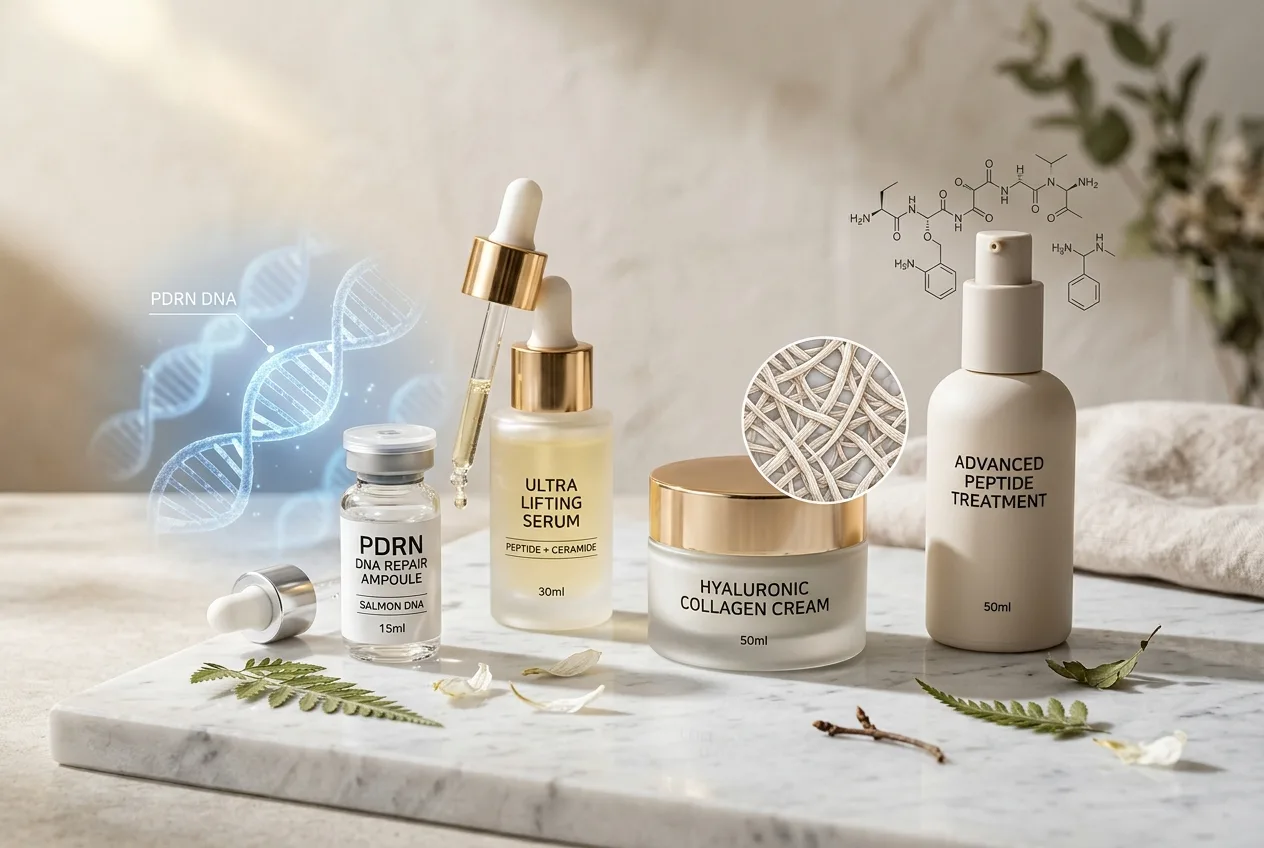
Polydeoxyribonucleotide, or PDRN, is derived from salmon DNA fragments and has been used in Korean medical aesthetics for wound healing and tissue regeneration for years before transitioning into cosmetic skincare formulations. This clinical heritage gives Korean manufacturers a formulation depth with PDRN that manufacturers elsewhere simply have not had the time or infrastructure to develop.
In cosmetic applications, PDRN activates adenosine receptors in the skin, triggering biological repair processes including collagen stimulation, improved microcirculation, and overall tissue regeneration. These are not surface-level cosmetic benefits. They are biological mechanisms with documented clinical precedent, which is exactly what makes PDRN-based formulations so commercially powerful in premium and aesthetic channel positioning.
Working with a specialist PDRN ampoule manufacturer gives brands access to this ingredient at the formulation quality level its clinical origin story deserves. Sourcing, concentration, stabilization, and delivery all require expertise that only manufacturers with genuine PDRN experience can reliably provide.
Advanced Peptide Complexes: Korea's Anti-Aging Workhorse
Peptides have been central to Korean anti-aging formulation for years, and the sophistication of peptide technology available through Korean OEM manufacturing has advanced considerably beyond the basic blends that first introduced this ingredient category to global consumers.
Here is how Korean anti-aging peptide formulation currently breaks down across different mechanisms:
| Peptide Type | Biological Target | Consumer Benefit |
| Signal Peptides | Fibroblast activation for collagen and elastin synthesis | Improved firmness and fine line reduction over consistent use |
| Carrier Peptides | Mineral delivery to repair sites in the skin | Enhanced wound healing and collagen building support |
| Neurotransmitter-Inhibiting Peptides | Reduced intensity of muscle contractions at expression line sites | Visible softening of dynamic wrinkles around eyes and mouth |
| Biomimetic Peptides | Replication of natural skin protein structure and function | Structural skin integrity improvement and resilience |
| Enzyme-Inhibiting Peptides | Blocking of collagenase and elastase activity | Protection of existing collagen and elastin from enzymatic breakdown |
Korean formulators combine these peptide types strategically within single formulas, building multi-mechanism anti-aging products that address aging from several biological angles simultaneously rather than relying on a single peptide class for all performance claims.
Collagen Support: A Layered Korean Approach
Standard collagen products in the global market typically incorporate a single hydrolyzed collagen active at a concentration that sounds impressive on a label but delivers limited results because the molecule is too large to penetrate meaningfully through the skin barrier.
Korean collagen skincare OEM manufacturing approaches this challenge differently. Rather than relying on topical collagen delivery, Korean formulators build collagen support systems that work at multiple levels:
- Marine collagen fragments at sizes small enough for meaningful skin absorption
- Signal peptides that trigger the skin's own fibroblast cells to produce more collagen internally
- PDRN for cellular-level tissue regeneration that supports collagen network maintenance
- Antioxidant protection from ingredients like astaxanthin that prevent UV-induced collagenase activity from breaking down existing collagen
This layered strategy addresses both collagen production stimulation and collagen protection simultaneously, producing results that are both more visible and more lasting than single-ingredient collagen approaches.
The Lifting Serum: Where Korean Anti-Aging Formulation Excellence Is Most Visible
If there is one product format where the quality gap between Korean anti-aging OEM formulation and manufacturing in other regions is most commercially obvious, it is the lifting serum.
Consumer expectations for a premium lifting serum are high and specific. It must absorb quickly with no residue. It must feel luxurious from the first application. It must deliver a perceptible immediate tensing and firming effect. And over weeks of consistent use, it must produce visible improvements in facial contour and skin firmness that consumers notice and comment on.
Meeting all of these requirements simultaneously in a single stable formula is genuinely demanding formulation work. Korean manufacturers have developed this capability through years of serving one of the most ingredient-educated and results-oriented domestic skincare markets in the world.
Our Korean lifting serum OEM formulation available through the MD Nature Intensive Lifting Care Ampoule demonstrates this standard directly. The formula combines multi-peptide complexes for collagen stimulation, plant-derived tensing actives for immediate firming sensation, and hydrating ampoule bases that deliver the formula efficiently while maintaining a lightweight, residue-free skin feel that premium consumers expect.
Fermentation Science Strengthens Korean Anti-Aging Formulation
Fermentation technology adds another dimension to Korean anti-aging formulation that most other manufacturing regions have not developed to the same depth. The fermentation process breaks source ingredients into smaller, more bioavailable molecular forms while generating entirely new bioactive compounds including organic acids, enzymes, and antioxidants that were not present in the original material.
In the anti-aging context, fermented ingredients contribute several important benefits:
- Improved penetration of co-formulated actives through the skin barrier
- Antioxidant compounds that protect against oxidative aging at cellular level
- Brightening benefits that address the dullness dimension of skin aging
- Improved skin compatibility for mature skin that is often more reactive to concentrated actives
Combining fermented bioactives with peptide complexes, PDRN, and collagen-supporting ingredients creates synergistic anti-aging formulas where each component strengthens the overall performance of the others. This systems-thinking approach to anti-aging formulation is a defining characteristic of how Korean OEM manufacturers develop at the premium end of this category.
Global Market Demand for Korean Anti-Aging OEM
The commercial case for Korean anti-aging OEM manufacturing is supported by consistently strong global market demand across multiple regions and consumer segments.
| Market Region | Key Anti-Aging Consumer Demand | Strongest Korean OEM Product Categories |
| Southeast Asia | Brightening combined with anti-aging, early prevention focus | Vitamin C anti-aging serums, niacinamide lifting formulas |
| Middle East and GCC | Intensive anti-aging, luxury positioning, premium ingredients | PDRN ampoules, peptide lifting serums, collagen creams |
| North America | Clinical credibility, ingredient transparency, derma-adjacent | Ceramide anti-aging, peptide serums, barrier repair anti-aging |
| Europe | Clean formulation, natural origin bioactives, sustainability | Fermented anti-aging, plant peptides, botanical actives |
| East Asia | Advanced biotech, professional aesthetic crossover | Exosome ampoules, PDRN formulas, multi-peptide systems |
Understanding which regional demand profile best matches your target market helps Nutricare Cosmetic guide formulation direction, ingredient selection, and product format decisions that are commercially optimized for your specific launch context rather than generic across all markets.
What Brands Need to Prepare Before Starting Korean Anti-Aging OEM Development
Building a genuinely effective anti-aging product requires more upfront planning than a standard skincare launch. The consumer expectations are higher, the ingredient costs are more significant, and the regulatory scrutiny around efficacy claims is stricter than for basic skincare products.
Before beginning your Korean anti-aging OEM development, prepare clarity on the following:
- Your target consumer's specific aging concern: Are they focused on fine lines, firmness loss, dullness, or overall skin aging? The more specific the target, the more focused and effective the formula can be.
- Your distribution channel: The documentation requirements and claim standards differ significantly between mass premium retail, clinical channels, and luxury DTC.
- Your budget for development: Advanced anti-aging ingredients cost more than standard actives. Building in realistic budget for formulation, stability testing, and packaging at this quality level is essential for avoiding compromises that undermine the product's performance.
- Your efficacy documentation strategy: For anti-aging claims to hold up in competitive markets, having in-use testing data or consumer study results to support visible results claims gives your brand significantly stronger credibility.
At Nutricare Cosmetic, our team guides brands through all of these pre-development decisions as part of our Korean beauty brand development partner approach. We help brands identify the right formulation direction, set realistic timelines and budgets, and build anti-aging products that are both commercially positioned and scientifically credible from the ground up.
Final Thoughts
Korean anti-aging OEM formulation leads the global skincare manufacturing category because it combines the most advanced ingredient access, the deepest formulation expertise, and the most rigorous production standards available anywhere in the world. For brands serious about competing in the premium anti-aging market, Korea is not simply a convenient manufacturing option. It is the formulation foundation that gives your products the scientific substance your brand story needs to earn and keep consumer trust.
Frequently Asked Questions
Q1. Why do global skincare brands consistently choose Korean anti-aging OEM over other manufacturing regions?
Korean manufacturers combine advanced biotech actives like PDRN and exosomes with multi-mechanism peptide formulation and GMP certified production. This combination of ingredient depth and manufacturing precision produces anti-aging results other regions consistently struggle to match.
Q2. What makes PDRN such a commercially valuable ingredient in Korean anti-aging OEM formulations?
PDRN activates biological repair processes including collagen stimulation and tissue regeneration through adenosine receptor activation. Its clinical heritage in Korean medical aesthetics gives Korean manufacturers formulation expertise with this ingredient that manufacturers elsewhere have not had time to develop.
Q3. How do Korean lifting serum OEM formulations deliver both immediate and long-term anti-aging results?
Korean lifting serums combine immediate tensing plant actives for perceptible firming on application with long-term collagen-building peptides and PDRN that improve facial contour and skin firmness over consistent use, delivering both sensory satisfaction and biological skin improvement simultaneously.
Q4. Which global markets have the strongest demand for Korean anti-aging OEM products right now?
The GCC and Middle East drive strong demand for luxury PDRN and peptide ampoule formats. Southeast Asia favors brightening combined with anti-aging. North America and Europe are growing strongly in clinically positioned ceramide and peptide anti-aging formulations with ingredient transparency emphasis.
Q5. How long does Korean anti-aging OEM development take from initial brief to finished product?
Custom anti-aging OEM development typically takes four to six months covering formulation strategy, sample development, revision rounds, stability testing, and production. Biotech-focused formulas involving PDRN or exosomes may require additional specialized testing time beyond the standard timeline.
About the author
Nutricare Cosmetic
Nutricare Cosmetic is a leading Korean skincare manufacturer specializing in OEM cosmetic manufacturing in South Korea and the USA. As one of the trusted South Korean cosmetic manufacturers, the company provides end-to-end OEM & ODM skinca…
Last updated . If you spot an error, contact our newsroom with the article link and supporting information.