How Much Does a Poultry Farm Biogas Plant Cost in India? (2026 Guide)
Story details
- Written by
- Koshish India
- Published
- Read time
- 5 min
- Reads
- 1
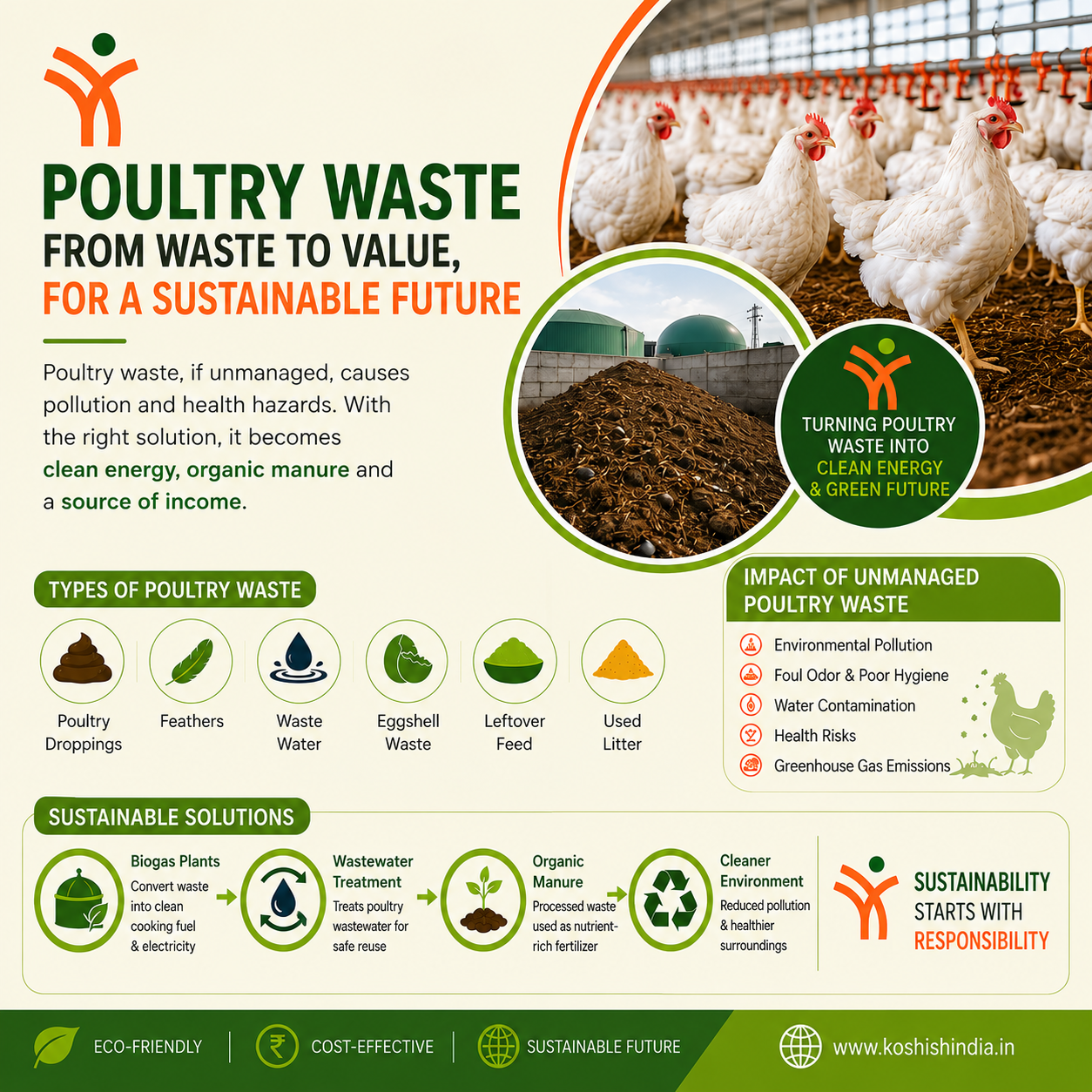
While you are contemplating the construction of a poultry farm biogas plant, there are many questions that crop up in your mind. One of those questions is: What would be its cost? The cost of a biogas plant for poultry farm would depend on the size of the farm, the number of birds, the amount of waste generated per day, and the type of technology used. Poultry farm biogas plant is an excellent choice which not only helps you generate biogas but also saves money.
In this guide to 2026, we will provide you with the details of the cost of a commercial biogas plant and all the factors affecting the cost.
What Is a Poultry Farm Biogas Plant?
Poultry Farm Biogas plant is an energy system where poultry litter is converted to biogas using the anaerobic digestion process. The generated biogas can be utilized in cooking, production of electricity, or heating, while the remaining slurry forms organic fertilizer.
Conversion of poultry waste to biogas offers several benefits such as efficient biogas plant for poultry farm disposal of waste, odor reduction, reduced emissions of greenhouse gases, and provision of renewable energy for poultry farms.
How Much Does a Poultry Farm Biogas Plant Cost in India?
The cost of a poultry biogas plant varies with its capacity and the farm's requirements.
Farm Size | Approximate Bird Count | Estimated Cost Range |
Small Farm | 10,000-20,000 birds | ₹35000 onwards |
Medium Farm | 50,000 - 100,000 birds | ₹4,000,000 onwards |
Large Commercial Farm | 100,000+ birds | 1Cr onwards |
*Note: These are indicative estimates. The actual cost depends on project specifications, equipment, civil work, automation, and site conditions.
Factors Affecting Poultry Farm Biogas Plant Cost
Various factors affect the total cost of the poultry farm biogas plant project:
1. Size of the Farm and No. of Birds
The more the birds in the farm, the more will be the poultry litter. It helps in increasing the size of the commercial biogas plant digester and equipment which will be used.
2. Amount of Poultry Waste Generated Per Day
The capacity of the poultry farm biogas plant to be installed depends upon the amount of waste generated per day.
3. Capacity of the Plant
A larger capacity of the biogas plant for poultry farm helps in producing more output but requires large sized digesters, storage tanks, and gas handling systems.
4. Technical Advance and Automation
Systems for monitoring, automatic feeding system, gas purification system, and generation of electricity from the power require more money but improve the efficiency of operation.
5. Civil Works and Installation
Civil works for preparing the land, foundation work, pipe lines, storage tanks, etc., and also manpower cost vary from location to location and increase the cost of the project.
Government Subsidies and Financial Support
The Government of India promotes bio-energy projects through different schemes. Based on the size of the project, location, and its usage, the qualified poultry farmers can avail themselves of financial aids through different schemes of renewable energy and poultry waste to biogas.
The financial aids can comprise:
Capital subsidy for eligible projects
Soft loans from financial institutions
Incentives from the state level for renewable energy for poultry farms projects
Financial aid through bio-energy promotion schemes (eligibility criteria subject to)
As the subsidy rules keep on changing, the farmers must approach authorized government departments or experts of biogas solutions.
Is a Poultry Biogas Plant Worth the Investment?
However, for medium to big size poultry farm investments in the biogas plant for poultry farm will be profitable from many aspects.
These are some of the main advantages of using a poultry farm biogas plant in a poultry farm:
Waste management at lower costs
Less dependency on LPG/diesel/electricity
Organic fertilizer as by product
Controlled odour management
Renewable energy source for poultry farm biogas plant
Carbon footprints minimized
Proper use will result in savings which can cover investments made.
Wrapping Up
A poultry farm biogas plant is more than just a waste management solution, it is a long-term investment in sustainable farming. By converting poultry waste to biogas, poultry farmers can reduce operational costs, generate clean energy, and produce high-quality organic fertiliser. Despite the fact that the cost of building a commercial biogas plant is influenced by the size of the farm, number of birds, and technology used, the benefits are still worth taking into account.
In 2026, there will be a constant demand for renewable energy in poultry farms, which means that the installation of a poultry biogas plant may prove beneficial for poultry companies..
Frequently Asked Questions (FAQs)
1. What is the minimum farm size that will require a poultry farm biogas plant?
Poultry farms that have 5,000 birds or even more are more appropriate for the installation of a commercial biogas plant, but this requirement varies based on the amount of daily waste produced.
2. Is poultry manure able to produce biogas alone?
Yes. However, poultry litter could be used together with water, and sometimes with other kinds of organic waste, which helps digest the material easier.
3. Are there any government subsidies for the construction of poultry farm biogas plants?
Yes. Ineligible projects could receive government subsidies through central or state bioenergy schemes.
4. How long does it take to get back the money spent on the poultry farm biogas plant construction?
The return on investment time is determined by the size of the biogas plant, its utilization, efficiency, and savings on energy and waste management. Many projects manage to recover their investments in a matter of a few years.
5. Is it possible to use poultry biogas plant for the production of electricity?
Yes. Biogas could be utilized for cooking, heating, and for generating electricity through a biogas generator.
Domestic Biogas , Commercial Biogas , BioGas , Sewage Water Treatment Plant , Effluent Water Treatment Plant , Zero Liquid Discharge Water Treatment Plant
Powered by Froala Editor

About the author
Koshish India
https://koshishindia.in/
Last updated . If you spot an error, contact our newsroom with the article link and supporting information.