Who is Eligible to Apply for a Commercial Biogas Plant Subsidy?
Story details
- Written by
- Koshish India
- Published
- Read time
- 4 min
- Reads
- 4
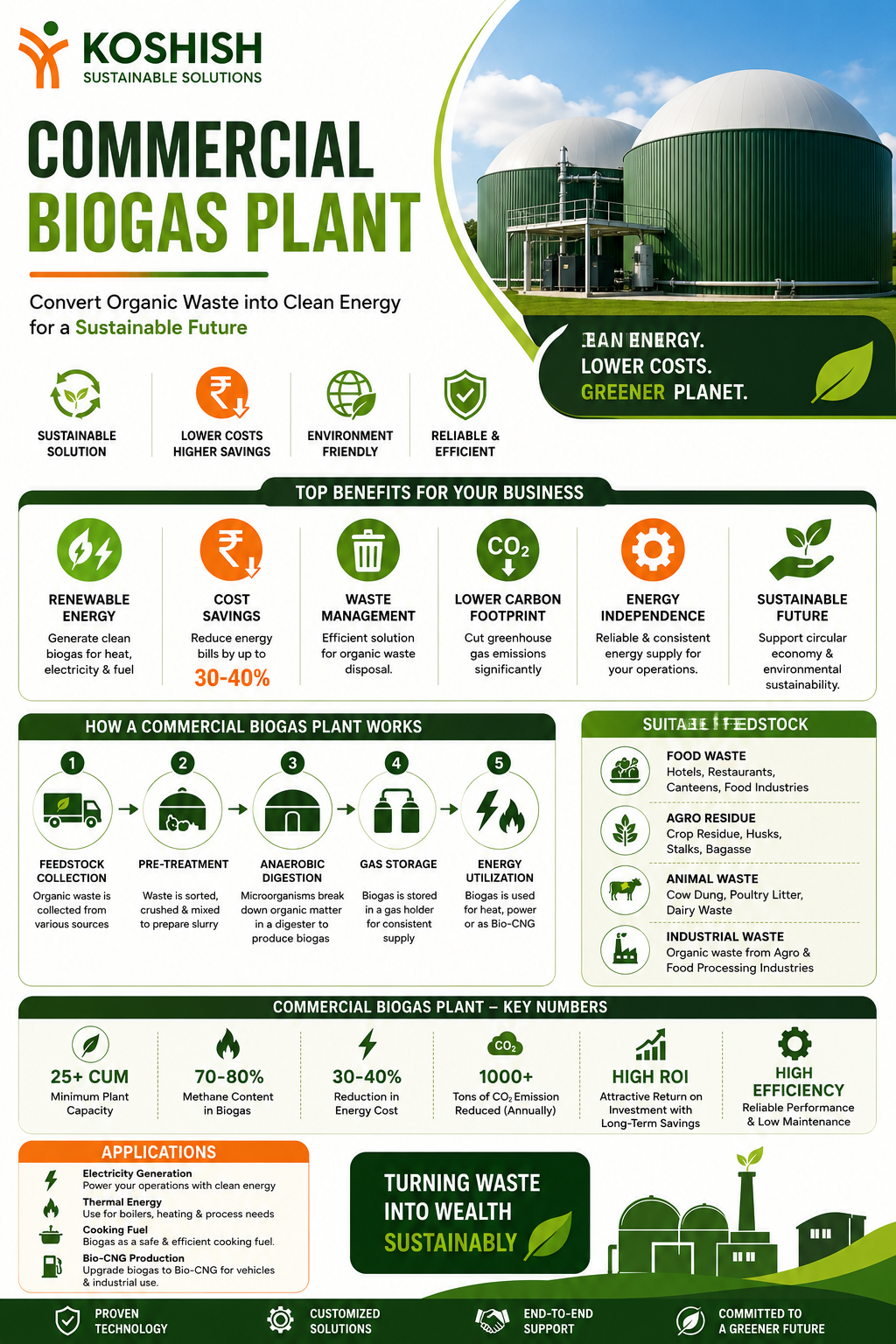
With a focus on getting better energy options, commercial biogas plants are now an ideal investment option. Biogas plants produce renewable biogas and valuable organic manure from organic waste matter and enable companies to save money on waste management. Various renewable energy subsidies are provided by the Government of India to make this project successful.
But most business people wonder, Who can apply for a subsidy for Commercial Biogas Plant? Information about the criteria for eligibility and government schemes can provide an easy way forward for businesses.
In this blog post, we discuss the Biogas plant eligibility criteria, government incentives, documents needed, and the advantages of applying for Biogas Plant Subsidy in India.
What Is a Commercial Biogas Plant?
A Commercial Biogas Plant is an industrial-scale anaerobic digester system intended to treat organic waste from industries, agriculture, municipalities, hotels, food processing facilities, dairies, poultry farms, and other commercial biogas plant sectors. Biogas generated by the plant is capable of being used for producing electricity, providing heat or used for cooking, or converted into compressed biogas (CBG) for use as vehicular fuel.
Apart from producing renewable energy, such plants are also useful for organizations in managing waste and reducing carbon footprints.
Who Can Apply for a Commercial Biogas Plant Subsidy?
The Government Biogas Subsidy Scheme is normally applicable for organizations implementing an eligible commercial biogas project. The applicants can be:
Poultry farm
Dairy farm
Gaushala
Food processing industry
Hotel/Restaurant
Municipal corporation
Sugar mill/distillery
Agro-processing industry
Private firms and MSMEs
Farmer Producer Organization (FPO)
Cooperative
The project should apply the approved technology and comply with the technical norms specified by the concerned Government Biogas Subsidy agency.
What Are the Eligibility Criteria for the Subsidy?
Eligibility criteria of a Commercial Biogas Plant may change according to the scheme. Nevertheless, the firms need to fulfill the following criteria:
The project should make use of biodegradable organic waste.
The plant should abide by the technical standards set.
The project should comply with environment and pollution regulations.
The firm should have legal right or lease over the project site.
The capacity of the plant should fulfill the minimum requirements as per the scheme.
The installation of the plant should be carried out by an authorized technology vendor or project developer.
The project should have obtained the approvals from the local authorities.
Which Government Schemes Support Commercial Biogas Plants?
Several government programs encourage renewable energy sources and waste management systems with Commercial Biogas Plant Subsidy in India.
Few important programs include:
National Bioenergy Program (MNRE): The MNRE encourages biogas and bioenergy projects through financial aid for the projects as a part of the National Bioenergy Program.
GOBARdhan Program: GOBARdhan program provides an incentive for conversion of organic waste to useful products like biogas and organic manure.
SATAT Program: SATAT program is an initiative for production of Compressed Biogas (CBG) from agriculture and organic waste and generating business opportunities.
Subsidy Programs of State Governments: Many states also provide their own subsidy programs for biogas projects depending upon the renewable energy policy of the states.
How Can Businesses Benefit from the Subsidy?
Applying for a Commercial Biogas Plant subsidy offers several long-term advantages.
Other major advantages are:
Reduction of the initial capital outlay
Boosting ROI of the project
Cutting costs on waste disposal
Generating renewable energy for captive consumption
Manufacturing organic bio-fertilizer as a supplementary income source
Compliance with environmental regulations
Reducing greenhouse gas emissions
Increasing sustainability and ESG
Achieving energy independence
The implementation of commercial biogas projects is thus economically and environmentally viable due to government support.
Wrapping Up
A Commercial Biogas Plant Investment is becoming an increasingly attractive choice for companies that want a sustainable means of waste disposal and production of renewable energy. There are several schemes offered by the Government Biogas Subsidy to help cut down on costs involved in setting up such plants commercially.
The company should first understand the Biogas Plant Eligibility requirements, gather necessary documentation, and select the most appropriate scheme provided by the government. It may also be helpful to work together with a professional biogas technology firm to help ease the process and get the subsidy.
Frequently Asked Questions (FAQs)
1. Who can apply for a commercial biogas plant subsidy?
Commercial Biogas Plant Subsidy in India are generally available to poultry farms, dairy farms, food processing industries, hotels, municipalities, MSMEs, cooperatives, FPOs, gaushalas, and other organizations that generate sufficient biodegradable organic waste.
2. What are the eligibility criteria for the Biogas Plant Subsidy in India?
Applicants typically need a suitable project site, adequate organic waste availability, approved plant technology, compliance with environmental regulations, and all necessary project approvals as specified under the applicable government scheme.
3. Which government schemes support commercial biogas plants?
Major schemes include the National Bioenergy Programme (MNRE), GOBARdhan Scheme, SATAT Initiative, and various Biogas Plant Subsidy in India programs offered by state governments.
Domestic Biogas , Commercial Biogas , BioGas , Sewage Water Treatment Plant , Effluent Water Treatment Plant , Zero Liquid Discharge Water Treatment Plant
Powered by Froala Editor

About the author
Koshish India
https://koshishindia.in/
Last updated . If you spot an error, contact our newsroom with the article link and supporting information.