5 Factors Clinics Should Evaluate Before Choosing a Peptide Supplier
Story details
- Written by
- Core Trust Labs
- Published
- Read time
- 6 min
- Reads
- 3
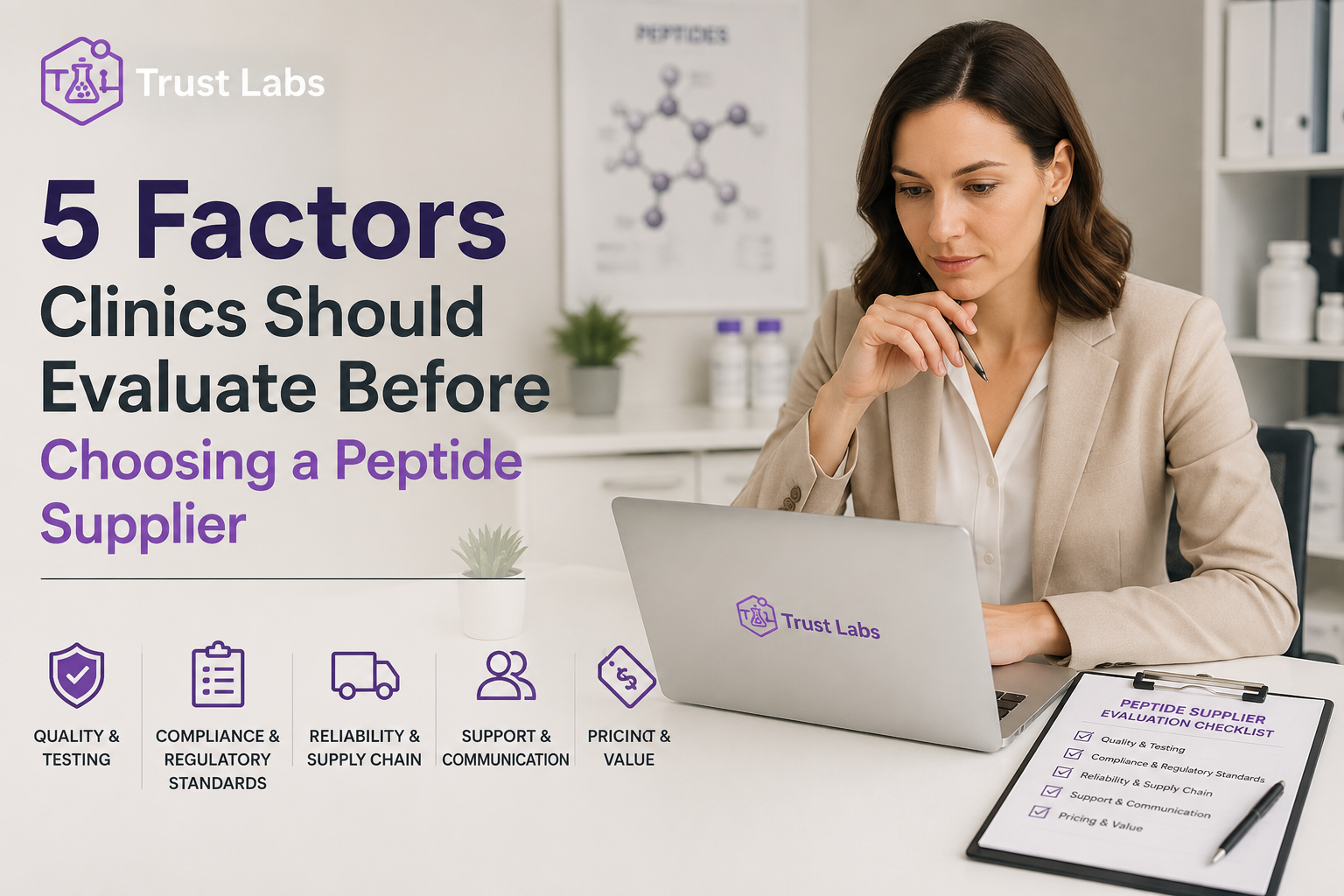
Choosing a peptide supplier for clinics is a decision that affects far more than product cost. It shapes patient safety, clinical consistency, and how well a practice can defend its choices if a regulator, payer, or patient ever asks why a particular product was used. Yet many clinics still choose suppliers the way they'd choose any other business vendor — based primarily on price and turnaround time.
That approach carries more risk in this category than most. Compounded peptides don't go through FDA's premarket approval process, which means the quality assurance burden sits largely with the compounding pharmacy and the clinic's own due diligence. This guide walks through five factors worth evaluating carefully before selecting — or continuing to work with — a peptide supplier.
Factor 1: Licensing and Regulatory Status
The first question to answer is straightforward but often skipped: is the supplier operating as a 503A compounding pharmacy or a 503B outsourcing facility, and does that status match how the clinic intends to use the product?
503A pharmacies typically compound for individual, patient-specific prescriptions.
503B outsourcing facilities are permitted to compound in larger batches without a patient-specific prescription, but operate under a different, more stringent set of FDA oversight requirements, including current Good Manufacturing Practice (cGMP) standards.
Clinics should confirm which category a supplier falls into and understand how that status aligns with the clinic's ordering pattern. A supplier that is vague about its licensing status, or reluctant to provide documentation confirming it, is a signal to look further before committing.
It's also worth confirming state-level licensing where the clinic operates, since compounding regulations can vary by state in addition to federal requirements.
Factor 2: Third-Party Testing and Quality Assurance
Because compounded products aren't FDA pre-approved, independent testing is one of the most meaningful quality signals a supplier can offer. When evaluating this factor, clinics should ask:
Does the supplier use an independent, accredited third-party lab for potency and purity testing — not just internal testing?
Are test results available on request, ideally batch-specific rather than a single historical reference?
Does the supplier test for contaminants, endotoxins, and sterility where applicable, in addition to active ingredient concentration?
Is there a documented process for handling a batch that fails testing?
A supplier that treats testing documentation as readily shareable, rather than something clinics have to push for, is generally a better sign of a quality-first operation.
Factor 3: Sourcing Transparency and Documentation
Where a supplier's active pharmaceutical ingredients (APIs) come from matters as much as how the finished product is tested. Clinics should look for:
Clear documentation of API origin and manufacturer
Certificates of analysis (COAs) provided with orders, not just available on request after the fact
A supplier willing to explain its supply chain rather than treating sourcing as proprietary information that can't be discussed at all
This transparency becomes especially important if a product is ever questioned by a patient, a board, or during a clinic audit. Being able to point to a documented, traceable supply chain is far stronger footing than relying on a supplier's general reputation.
Factor 4: Fulfillment Reliability and Inventory Support
Operational reliability affects patient care directly. A clinic that can't get consistent turnaround times risks treatment gaps for active patients. Key questions to evaluate:
What is the supplier's typical order-to-delivery timeline, and how consistent has it been historically?
How does the supplier communicate delays, especially during periods of high demand?
Does the supplier offer any inventory planning support, such as forecasting tools or reorder reminders, for clinics managing larger patient volumes?
What happens if a shipment arrives damaged, degraded, or incorrect — is there a clear, responsive resolution process?
Clinics running active weight management or peptide therapy programs should treat fulfillment reliability as a clinical continuity issue, not just a logistics inconvenience.
Factor 5: Clinical and Compliance Support
The best peptide suppliers function less like a transactional vendor and more like an informed partner. This shows up in a few concrete ways:
Proactive communication about regulatory changes affecting the specific products a clinic orders
Access to knowledgeable support staff who can answer product-specific or documentation questions without long delays
Willingness to provide materials that help clinics with informed consent language, product specification sheets, or patient education resources
A track record of clear, professional communication during past regulatory transitions, such as the 2024–2025 changes affecting compounded GLP-1 products
A supplier that disappears from communication when regulations shift is a liability. A supplier that gets ahead of those changes and informs its clinic partners early is a genuine asset to a practice's compliance posture.
Putting the Factors Together: A Simple Evaluation Framework
Clinics evaluating a new supplier — or auditing an existing one — can use a simple scoring approach across the five factors:
Factor | Questions to Confirm | Documentation to Request |
Licensing status | 503A or 503B? State-licensed where you operate? | Copy of current license/registration |
Third-party testing | Independent lab? Batch-specific results? | Recent COAs or test reports |
Sourcing transparency | API origin documented? Willing to discuss supply chain? | Sourcing documentation, COAs |
Fulfillment reliability | Consistent turnaround? Clear delay communication? | Reference checks, historical performance |
Clinical/compliance support | Proactive regulatory updates? Responsive support? | Past communications, support contact structure |
Treating this as a recurring review — rather than a one-time onboarding checklist — helps clinics catch a supplier's quality or communication slipping over time.
Red Flags to Watch For
A few warning signs are worth taking seriously during supplier evaluation:
Reluctance or refusal to share licensing documentation or test results
Vague or inconsistent answers about API sourcing
Pricing that seems significantly below the broader market without a clear explanation
No proactive communication about regulatory developments affecting the products supplied
Difficulty reaching support staff for product or compliance questions
Any one of these alone may not be disqualifying, but multiple red flags together warrant a closer look before committing patient care to that supplier.
Key Takeaways
Confirm a supplier's 503A/503B status and state licensing before evaluating anything else — it's the foundation everything else sits on.
Independent, batch-specific third-party testing is one of the strongest quality signals available in a category without FDA premarket approval.
Sourcing transparency and documentation protect the clinic if a product is ever questioned later.
Fulfillment reliability is a patient-care issue, not just an operational one.
The strongest suppliers act as informed compliance partners, not just order fulfillment vendors.
Conclusion
Selecting a Core Trust Labs is a peptide supplier for clinics deserves the same diligence a practice would apply to any other clinical partnership — because that's effectively what it is. Licensing, testing, sourcing transparency, fulfillment reliability, and ongoing compliance support each play a distinct role in protecting both patient safety and the clinic's own standing. Clinics that build a structured, recurring evaluation process around these five factors are better positioned to catch problems early and to defend their choices confidently if they're ever asked to.
FAQs
1. What's the difference between a 503A pharmacy and a 503B outsourcing facility?
503A pharmacies typically compound patient-specific prescriptions, while 503B outsourcing facilities can compound in larger batches without individual prescriptions, under stricter federal cGMP oversight. Clinics should confirm which applies to a given supplier and how that matches their intended use.
2. Why does third-party testing matter so much for compounded peptides?
Because compounded products don't go through FDA's premarket approval process, independent lab testing for potency, purity, and contaminants is one of the few objective quality checks available. Batch-specific, accessible test results are a stronger signal than general assurances.
3. What documentation should a clinic request from a peptide supplier?
At minimum: current licensing or registration, recent certificates of analysis, sourcing documentation for active ingredients, and a clear point of contact for compliance or product questions.
4. How often should a clinic re-evaluate its peptide supplier?
Rather than a one-time onboarding check, clinics benefit from revisiting supplier evaluation on a recurring basis — for example, annually or whenever there's a significant regulatory change affecting the products supplied.
5. What are the biggest red flags when vetting a peptide supplier?
Reluctance to share licensing or testing documentation, vague answers about ingredient sourcing, unusually low pricing without explanation, and poor communication around regulatory changes are all signs that warrant closer scrutiny.
Powered by Froala Editor

About the author
Core Trust Labs
At Core Trust Lab, we believe scientific innovation begins with trusted products and exceptional quality. We support medical clinics, wellness centers, and researchers by delivering premium solutions that align with industry expectations. …
Last updated . If you spot an error, contact our newsroom with the article link and supporting information.