Let's be honest nobody actually enjoys reading a 90-page PDF. Whether it's a research paper, a legal contract, a government report, or a 200-page financial audit, we all end up doing the same thing: scrolling endlessly, squinting at dense paragraphs, and hoping we don't miss something important. Sound familiar?
That's exactly why AI chat with PDF tools have exploded. And no, this isn't just another tech trend for developers or data scientists. This is genuinely useful technology that students, lawyers, doctors, and business professionals are quietly using every single day to save hours of their lives.
The problem? Most people only know about one or two AI PDF tools and they're not always the best ones. So, let's fix that. Here's an honest look at what these tools actually do, which ones stand out, and what you should look for before picking one.
What Is "AI Chat with PDF" And Why Is Everyone Suddenly Talking About It?
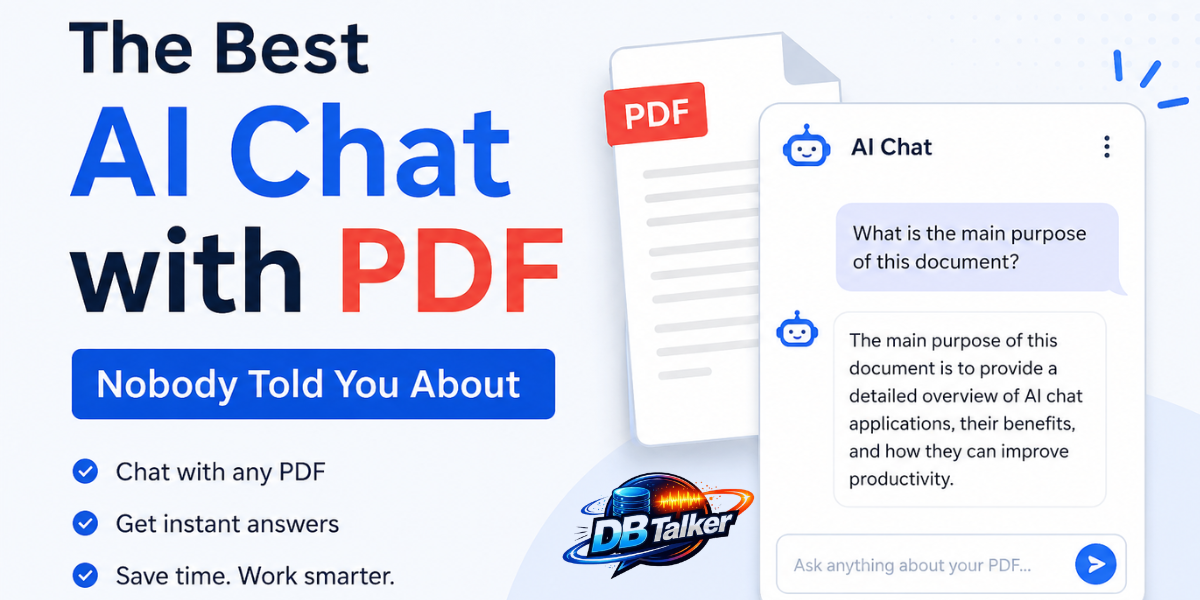
Think of it like having a conversation with your document. You upload a PDF, and instead of reading it yourself, you just ask it questions. "What's the main conclusion?" "Summarize section 3." "What are the payment terms in this contract?" The AI reads the entire document, understands the context, and gives you direct, accurate answers in plain English.
Why is this trending right now?
Because the use cases are everywhere:
- Students summarizing textbooks and research papers before exams
- Legal professionals reviewing contracts without reading every clause
- Healthcare workers navigating clinical guidelines and patient documentation
- Business analysts extracting insights from reports and financial statements
- Researchers comparing findings across multiple academic papers
The demand has created a whole category of tools and they're not all equal.
The Best AI PDF Chat Apps You Should Actually Know About
1. DBTalker — The One Built for Real Document Work
If you haven't heard of DBTalker AI Chat with PDF you're missing out on one of the most practical tools in this space. What makes DBTalker genuinely different is its focus on document intelligence not just summarizing, but actually understanding what's inside your file so you can have a real, back-and-forth conversation with it.
Here's what sets it apart:
- Handles multiple file types — Not just PDFs. Word documents (.docx), Excel, CSV, JSON, TXT, and even website URLs. You can chat with almost any data source.
- Supports scanned and password-protected PDFs — This is huge. Most tools fail on scanned files. DBTalker handles them.
- Designed for professionals — The interface is built for people who need accurate, fast answers, not just surface-level summaries.
- Privacy-first — Encrypted uploads, no third-party data sharing, and secure processing systems.
- Free to try — You can upload your PDF and start chatting without pulling out a credit card.
Whether you're a student trying to decode a complex research paper or a lawyer identifying key clauses in a 50-page agreement, DBTalker is built for that kind of serious document work.
👉 Try it here: DBTalker Today!
2. ChatPDF
One of the earlier players in this space. ChatPDF is simple, fast, and great for casual use uploading a single PDF and asking a few quick questions. It works well for students and light research but has limitations on file size and doesn't support non-PDF formats. Good starting point, but you'll outgrow it quickly if your needs are professional.
3. Adobe Acrobat AI Assistant
Adobe added an AI chat layer to Acrobat, which sounds convenient since you're already working in the app. It works decently for summarization, but it's locked behind a premium subscription and is primarily focused on standard PDF text. If you're already a heavy Acrobat user, it's worth exploring otherwise, it's an expensive option for what you get.
4. Humata AI
Humata is popular among researchers and academics. It does a solid job of understanding scientific language and long-form papers. The interface is clean, citations are referenced well, and it's particularly useful for comparing across multiple documents. Limited format support outside of PDFs, though.
5. Docsumo
More of an enterprise-grade tool for data extraction and document automation. If you're processing invoices, forms, or structured documents at scale, Docsumo is worth a look. For the average user who just wants to chat with a PDF, it's overkill.
What to Look for in an AI PDF Chat Tool?
There are dozens of these apps now, and they're not all built the same. Here's what actually matters:
✅ Accuracy over everything The AI needs to understand context, not just match keywords. Ask it a nuanced question and see if it gives you a relevant, specific answer — or a vague, generic one.
✅ File size and format support Can it handle your 100MB scanned contract? Does it support Word docs or just PDFs? DBTalker, for instance, supports PDFs up to 50MB along with Word, Excel, CSV, JSON, and TXT formats — rare for a single tool.
✅ Privacy and security You're uploading real documents — possibly sensitive ones. Check if the tool encrypts your data, how long files are stored, and whether your data is used for training.
✅ Ease of use A great AI tool shouldn't feel like work. Upload, ask, get answers. That's the experience you should expect.
✅ Free tier available Most reputable tools offer a free version. If they don't, that's a red flag. Try before you pay.
The Bottom Line
AI chat with PDF isn't a gimmick. It's become an essential productivity tool for anyone who works with documents which, honestly, is most of us. The best tools in this space are accurate, fast, support multiple file formats, and respect your privacy. DBTalker checks all of those boxes and goes further with support for documents beyond just PDF making it one of the most versatile options available right now.
If you haven't tried it yet, there's really no reason to wait. You can upload a PDF and have a conversation with it in less than a minute completely free.
Stop scrolling through endless pages. Start asking. 👉 Try DBTalker Today Free
Powered by Froala Editor
You may also like
More from this category.

Casino Non AAMS: Guida a Giochi Licenze e Bonus
Streamlining Your Application Strategy with Advanced Writing Platforms

Locksmith: Reliable Security Solutions for Every Property

540iy XHZ35E0J Model: A Detailed Guide for Product Research

The Home Mechanic's Resource Board: Organizing Workshop Manuals That Actually Get Used

What Should I Look for When Hiring a Wealth Management Company in Dubai?

Future Growth Prospects of the Global Raman Spectroscopy Market

China Smart LED Lighting Market Advancing Automation, Connectivity & Lighting Efficiency

Authorized Mobile Retail Store: 10 Things to Check Before Buying a Smartphone