Facing Confusion About Career Options? Smart Strategies to Study Australia for Singapore Students
Story details
- Written by
- Suraj
- Published
- Read time
- 6 min
- Reads
- 23
Introduction: Too Many Options, Too Little Clarity?
You've just finished your O-Levels or are midway through A-Levels. Everyone's asking: "What do you want to do after school?"
And honestly? You have no idea.
Sound familiar?
Many Singapore students feel overwhelmed when thinking about overseas universities — especially when Australia keeps coming up as a top choice. Great universities, diverse courses, post-study work options… but where do you even start?
If you're seriously considering to study in Australia with expert admission guidance, this article breaks it all down — clearly, practically, and without the confusion.
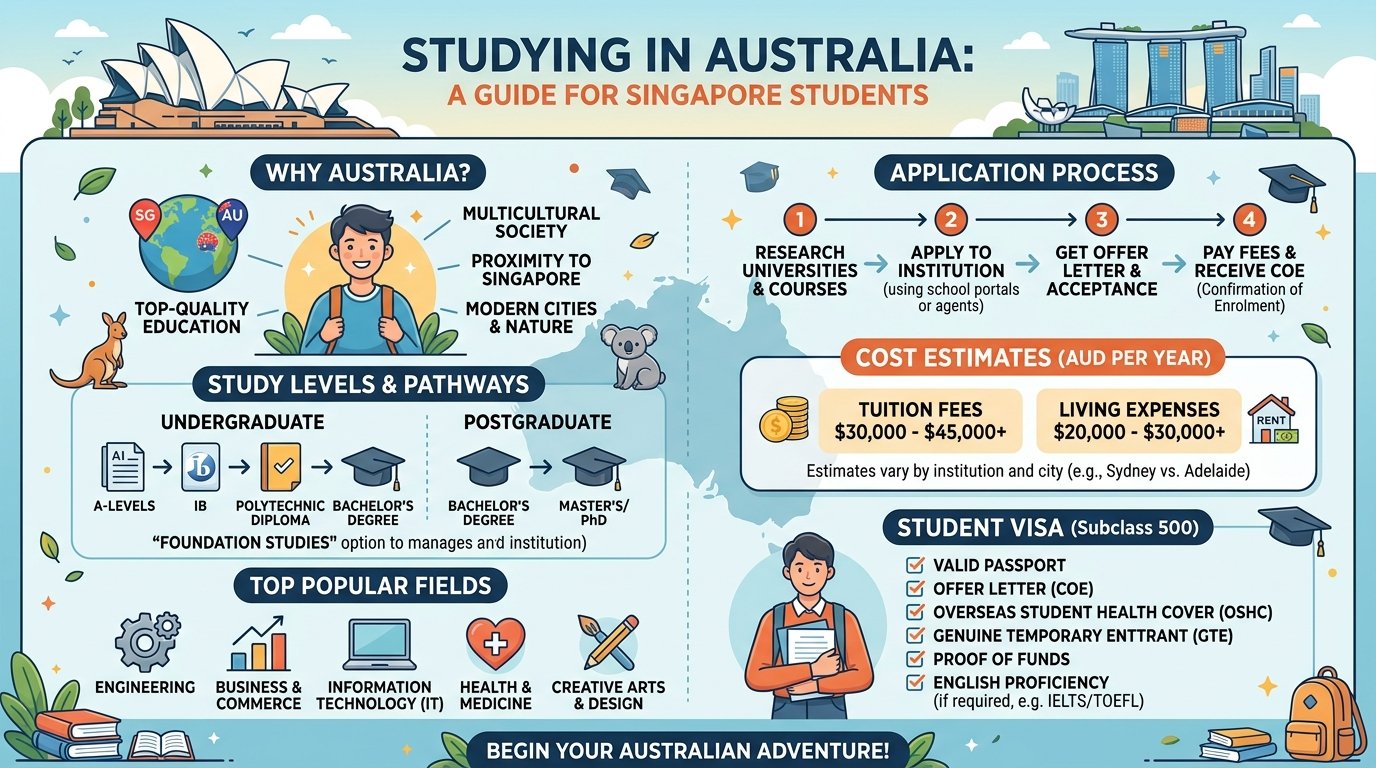
Why Singapore Students Choose Australia
Australia isn't just close to Singapore — it's genuinely one of the best countries for international students.
Here's why it makes sense:
Flight time: Just 7–8 hours from Singapore
8 universities in the QS World Top 100 (2024)
Post-Study Work Visa: Up to 4–6 years depending on location
Safe, multicultural environment — large Singaporean and Asian student communities
English-medium instruction — no language barrier
According to Australia's Department of Home Affairs, Singapore consistently ranks among the top 10 source countries for student visa applications.
Step 1: Identify Your Career Interest First
Most students make one big mistake — they pick a university before picking a career direction.
Don't do that.
Start by asking yourself:
What subjects do I actually enjoy?
Am I a problem-solver (Engineering, IT) or a people-person (Business, Psychology)?
Do I want a creative career or a technical one?
Quick Exercise: Write down 3 things you're good at and 3 things you enjoy. Where they overlap — that's your starting point.
Popular Course Categories in Australia for Singapore Students
Career Interest | Recommended Course | Top Universities |
Business & Finance | Bachelor of Commerce | University of Melbourne, UNSW |
Technology | Bachelor of IT / Computer Science | University of Sydney, ANU |
Healthcare | Bachelor of Nursing / Biomedical | Monash, University of Adelaide |
Creative Arts | Bachelor of Design / Media | RMIT, Curtin University |
Law | Bachelor of Laws | University of Queensland, UWA |
Engineering | Bachelor of Engineering | University of Melbourne, UNSW |
Step 2: Understand Entry Requirements Early
This is where many Singapore students lose time.
Australian universities accept multiple qualifications:
A-Levels (most widely accepted)
IB Diploma (highly valued)
Polytechnic Diplomas (accepted by many universities for direct entry or advanced standing)
SAT/ACT scores (accepted by select universities as supplementary proof of academic readiness)
Pro Tip: If you're sitting for the SAT or ACT, strong scores can actually strengthen your application — especially if your school results are borderline. For ACT prep support, ACT Test preparation programs can significantly improve your score before you apply.
Mini Case Study: Priya's Journey from Confusion to Clarity
Priya, 17, from Singapore — wanted to study something "related to business but also technology."
She initially applied for a pure Business degree. After a counselling session, she discovered Business Information Systems at UNSW — a perfect blend of both interests.
Result? She got in with her A-Level results and an SAT score of 1380.
Lesson: The right course exists. You just need to know where to look.
Step 3: Know the Australian University Intake Dates
Missing intake deadlines is one of the most common mistakes Singapore students make.
Intake | Application Period | Course Start |
Semester 1 (Main) | July – November | February |
Semester 2 | February – May | July |
Important: Some competitive programs (Medicine, Law, Architecture) have earlier deadlines. Always check individual university websites.
Step 4: Standardised Tests — Do You Need Them?
Short answer: Sometimes yes, always helpful.
SAT/ACT — Accepted by universities like Bond, Macquarie, and others as additional evidence of academic ability
IELTS/PTE — Required for international applicants (Singapore students with English-medium schooling often get exemptions)
Pro Tip from Our Tutors: Even if SAT/ACT isn't mandatory, a score above 1300 (SAT) or 27+ (ACT) signals academic seriousness to admissions officers. It can tip the scales in competitive programs.
Common Mistakes Singapore Students Make
Let's be direct. These are real mistakes — avoid them:
❌ Applying too late — Top courses fill up fast. Apply at least 6–8 months in advance.
❌ Ignoring scholarship deadlines — Many scholarships close before the general application deadline.
❌ Choosing a university by ranking alone — A top-ranked uni with the wrong course is worse than a mid-ranked uni with a perfect-fit program.
❌ Underestimating personal statements — Australian universities don't always ask for essays, but when they do, a generic statement kills your chances.
❌ Not checking credit exemptions — Poly diploma holders can often skip 1 year of university. Many don't claim this.
Step 5: Financial Planning — Be Realistic
Studying in Australia is an investment. Here's a rough annual breakdown:
Expense | Estimated Cost (AUD/year) |
Tuition Fees | AUD 28,000 – 45,000 |
Accommodation | AUD 12,000 – 20,000 |
Food & Living | AUD 8,000 – 12,000 |
Misc (transport, leisure) | AUD 3,000 – 5,000 |
Good news: International students in Australia can work up to 48 hours per fortnight during semester, helping offset living costs.
Also explore:
Australia Awards Scholarships
University-specific merit scholarships (many cover 10–25% of tuition)
Destination Australia Scholarships for students studying in regional areas
Step 6: Build a Strong Application Profile
For Singapore students who want to study Australia, the application goes beyond grades.
What Australian universities look for:
Academic transcripts
Predicted or final exam results (A-Level, IB, Poly)
English proficiency proof (if required)
Personal statement or SOP (for select courses)
Portfolio (for design, architecture, fine arts)
Reference letters (for postgraduate or competitive undergrad programs)
Actionable Tip: Start your personal statement 3 months before the deadline. Get it reviewed by someone with admissions experience — not just your school teacher.
Real Talk: Is Australia Right for You?
Ask yourself honestly:
Am I okay living independently at 18–19?
Can my family comfortably support AUD 40,000–55,000 per year?
Do I have a genuine interest in the course, not just "following friends"?
Am I prepared to commit to 3–4 years abroad?
If yes to most — Australia is an excellent choice. If unsure — that's okay too. A good counsellor will help you evaluate your options without pressure.
For personalised guidance, Test Prep with The Princeton Review Singapore offers expert admission counselling, SAT/ACT prep, and university application support tailored for Singapore students.
FAQs: Singapore Students Asking About Australia
Q1: Can I apply to Australian universities with Poly diploma results? Yes! Many universities accept polytechnic diplomas. Some even offer advanced standing (credit exemptions), letting you enter Year 2 directly.
Q2: Is the SAT required to study Australia? Not universally. But it can strengthen your application, especially if you're applying to competitive programs or scholarship rounds.
Q3: What's the easiest pathway for Singapore students? A-Level or IB → Direct entry to Year 1. Poly Diploma → Advanced standing in Year 2 at many universities.
Q4: How long does the student visa take? Typically 4–8 weeks after you receive your university offer. Apply early to avoid delays.
Q5: Are there Singaporean communities in Australian universities? Absolutely. Universities like UNSW, Monash, and Melbourne have large Singaporean student communities and active clubs.
Conclusion: Clarity Comes with Action
Confusion about career options is completely normal at 16–18 years old. The students who succeed aren't the ones who had everything figured out — they're the ones who started taking action early.
To study Australia successfully, you need: ✅ A genuine career interest ✅ The right course and university fit ✅ Strong academic preparation (including SAT/ACT if relevant) ✅ Early applications and financial planning ✅ Reliable, experienced guidance
Australia offers world-class education, a great lifestyle, and real career opportunities post-graduation. You just need a clear strategy — and now you have one.
Start early. Ask for help. Back yourself.
Powered by Froala Editor

About the author
Suraj
Contributor to TVL Health by The Viral Lines.
Last updated . If you spot an error, contact our newsroom with the article link and supporting information.